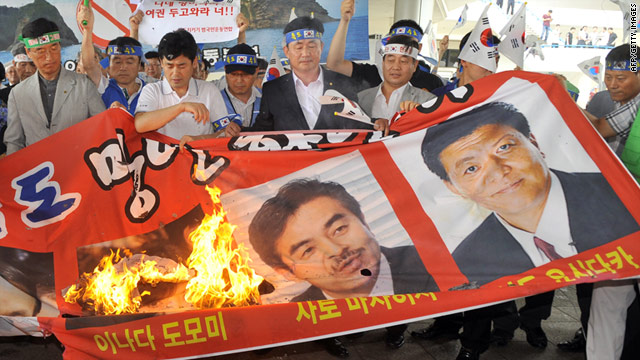
One of the claims in the article is that the Japanese lawmakers who were denied entry to Korea a couple of weeks ago were "attempting to visit the disputed islands of Dokdo/Takeshima." Another is that "Japan’s annexation of the islands [Dokdo/Takeshima] was among the first in a series of actions that led to the colonization of the peninsula."
Here is how I responded to the article, though it includes a few corrections to mistakes I found in my comment after it was posted:
There are many problems with this article.
First, the Japanese lawmarkers did not go to Korea to visit “Dokdo” (Takeshima). They went there to visit the Dokdo Museum on the Korean island of Ulleungdo, which is about ninety kilometers northwest of “Dokdo.” The museum houses maps and documents that Koreans say support their claim to “Dokdo.” The Japanese stated that they had no intention of visiting the disputed islets.
Second, Korea refuses to take the dispute to the International Court of Justice (ICJ) not because Koreans have some “powerful historical memory” of Japanese colonial rule, but because Korea has no maps or documents to support any historical claim to “Dokdo.” In other words, Korea knows the ICJ would rule against her.
The reason Korea has no maps or documents is that her claims were all fabricated shortly after World War II with the hope that she would be able to gain Japanese territory, which included not only “Dokdo” but also the Japanese island of Tsushima. The United States, however, rejected Korea’s claims. In an August 9, 1951 letter to the Korean ambassador, US Secretary of State Dean Rusk wrote the following.
“As regards the island of Dokdo, otherwise known as Takeshima or Liancourt Rocks, this normally uninhabited rock formation was according to our information never treated as part of Korea and, since about 1905, has been under the jurisdiciton of the Oki Islands Branch of Shimane Prefecture of Japan. The island does not appear ever before to have been claimed by Korea….”Korea never even attempted to provide the US with evidence to support her claim. Instead, Korean President Syngman Rhee simply declared “Dokdo” Korean territory after the 1951 Treaty of Peace with Japan, which allowed Japan to keep the island.
After visiting the Far East in 1954, US Special Mission Ambassador James Van Fleet wrote the following in his post-mission report:
"The Island of Dokto (otherwise called Liancourt and Take Shima) is in the Sea of Japan approximately midway between Korea and Honshu (131.80E, 36.20N). This Island is, in fact, only a group of barren, uninhabited rocks. When the Treaty of Peace with Japan was being drafted, the Republic of Korea asserted its claims to Dokto but the United States concluded that they remained under Japanese sovereignty and the Island was not included among the Islands that Japan released from its ownership under the Peace Treaty. The Republic of Korea has been confidentially informed of the United States position regarding the islands but our position has not been made public. Though the United States considers that the islands are Japanese territory, we have declined to interfere in the dispute. Our position has been that the dispute might properly be referred to the International Court of Justice and this suggestion has been informally conveyed to the Republic of Korea."While Korea has no old maps showing “Dokdo,” by any name, or any documents showing that Koreans ever visited the islets before the Japanese started taking them there as deckhands on Japanese fishing boats in the early 1900s, Japan has maps of the islets dating back to the 1600s and documents clearly describing them. Also, Japan officially incorporated “Takeshima” (Dokdo) into Shimane Prefecture in February 1905, after receiving a 1904 request to do so by a Japanese fisherman who was using the islets to capture and process sea lions.
The incorporation of Takeshima had nothing to do with the colonization of Korea. The islets were just a small group of rocks that had little or no strategic value and were not a part of Korea, so it is wrong for the writers of the article to write that “Japan’s annexation of the islands was among the first in a series of actions that led to the colonization of the peninsula.”
Korean “outrage” over Japanese claims to “Dokdo” is the result of about sixty years of fabricated Korean propaganda. It is not Japan who refuses to discuss the issues in the dispute; it is Korea. To solve the problem, Korean historians need to start telling the truth about the history of “Dokdo.”