竹島問題の歴史

Showing posts with label News. Show all posts

24.8.12

"Seoul to remove 'illegal' base of monument erected on Takeshima islet"

The Japanese newspaper Asahi Shimbu reports HERE that the South Korean government has said that the circular base for the "Dokdo" monument to the left, which was erected on Liancourt Rocks by Koreans, was constructed illegally and must be removed.

The monument, which was unveiled on August 19, was erected by North Gyeongsang Province without obtaining permission from the central government in Seoul. However, on the back of the monument is engraved with "President Lee Myung-bak, Summer of 2012" in the Korean President's own handwriting. The Korean name from the island is written in Korean on the front of the monument. The Korean central government has said that the part of the monument with the inscription can stay, but the circular base must go.

The Japanese newspaper describes the dispute over the islets as follows:
Known as Dokdo in South Korea, the islands have been occupied by South Korea since the early 1950s despite a lack of legal authorization from either Japan or the United Nations.
I would just add that the United States rejected the Korean government's claim to the islets in an August 10, 1951 letter from US Secretary of State Dean Rusk to the Korean Ambassador, in which the US Secretatry wrote the follow:
As regards the island of Dokdo, otherwise known as Takeshima or Liancourt Rocks, this normally uninhabited rock formation was according to our information never treated as part of Korea and, since about 1905, has been under the jurisdiciton of the Oki Islands Branch of Shimane Prefecture of Japan. The island does not appear ever before to have been claimed by Korea...."

17.8.12

Asahi Shimbun - "Takeshima issue explained in Q&A format"

Below is an August 16, 2012 article from the Japanese newspaper Asahi Shimbun. LINK

It is a pretty good article, but it oversimplifies the answer to the question, "What about the history?" It fails, for example, to mention that while Japan has numerous maps and documents to support her claim to Liancourt Rocks (Takeshima/Japan), Korea has none to support hers.

Also, how can Korea claim the Rocks were "taken by force" in 1905 when the Rocks had never been part of Korean territory or even had Koreans living on them? In fact, the only way Koreans could get to the Rocks at the time were as deckhands on Japanese fishing boats.
The Asahi Shimbun 
South Korean President Lee Myung-bak's surprise visit to the disputed Takeshima islets on Aug. 10 sent relations with Japan into a tailspin.  
Staff Writer Toru Higashioka attempts to put the issue in perspective in the following question-and-answer format:  
Question: What was the Japanese government's reaction to Lee's visit?
Answer: Both Prime Minister Yoshihiko Noda and Foreign Minister Koichiro Genba lodged strong protests.  
Q: What is the Japan's position with regard to the islets, which are called Dokdo in Korean?  
A: While South Korea claims the islets, Tokyo maintains they are Japan's sovereign territory, both historically and under international law. It also maintains that South Korea is illegally occupying them.  
Q: What is at issue right now?  
A: Lee's visit to Takeshima was an affront to Japan. Here was the leader of a country landing on territory it illegally occupies. His visit was completely unacceptable for the Japanese government.  
Q: Why does Japan maintain that South Korea is illegally occupying the islets?  
A: The 1951 San Francisco Peace Treaty stipulates all territory that Japan should renounce all rights, titles and claims to. But it does not include Takeshima. Then in January 1952, South Korean President Rhee Syngman one-sidedly declared the Rhee Syngman Line, or boundary, on the open sea, putting Takeshima on the South Korean side. South Korea went ahead and stationed security forces on the islets, effectively placing them under its control.  
Q: What about history?  
A: Japan claims it established sovereignty of the islets early in the Edo Period (1603-1867). Takeshima was incorporated into Shimane Prefecture based on a Cabinet decision in 1905. That same year, Japan declared that Korea no longer has diplomatic sovereignty as it moved to annex the Korean Peninsula in 1910. This is why South Koreans regard the islets as having been "taken by force." As a result, the issue has stirred up patriotism and anti-Japan sentiment among South Koreans.  
Q: How has Japan coped with the problem?  
A: In 1954 and 1962, Japan proposed to South Korea that the dispute over sovereignty be referred to the International Court of Justice. But South Korea rejected the idea. So far, Japan has refrained from taking the matter to the court out of consideration for its peaceful relationship with South Korea. Past attempts by Japan to resolve the issue in the ICJ were met with strong opposition from Seoul.  
Q: In spite of all this, Lee went ahead with the visit, didn't he?  
A: Genba said Japan no longer needs to give South Korea's stance on the issue any consideration and can go ahead with filing a suit with the ICJ.  
THE ASAHI SHIMBUN

9.7.12

Man Rams 1-ton Truck into Gate of Japanese Embassy in Seoul

At 4:55 a.m. on July 9th, a 62-year-old man from Seongnam City, South Korea drove a 1-ton truck into the front gate of the Japanese Embassy in Seoul, South Korea. Attached to the truck was a sign that read, "Dokdo Is Our Land." The man has been arrested.

(Photo from Joong-ang Ilbo Article HERE)

According to Seoul police, there were no injuries, but the front gate of the embassy has been pushed in about one meter.

The man told police that he was protesting a recent incident in which a Japanese man videotaped himself standing next to a "Comfort Women" memorial in front of the embassy with a stick that read, "Takeshima is Japanese Territory." Takeshima is the Japanese name for Dokdo, a small group of rocky islets that is the subject of a territorial dispute between Japan and South Korea. South Korea has illegally occupied the islets since the 1950s.

According to THIS Wall Street Journal blog article, police said the man had a hand-written note in his pocket that read as follows:
“... driving a stake at the comfort woman’s statue is doomed to God’s wrath. If I die please cremate me and scatter my ashes in the waters near Dokdo.”
The name "Comfort Women" was a euphemism that was once used by both Koreans and Japanese to refer to prostitutes, especially prostitutes for the military. Japan provided comfort women for its troops during World War II, and South Korea provided them for Korean and UN troops during the Korean War and beyond. The Korean newspaper Dong-a Ilbo reported in an October 1959 article HERE that there were 261,089 "comfort women" working in Korea in 1959 and that 66% of them were infected with a venereal disease.

KOREAN LINK

JAPANESE LINK

2.7.12

White House Rejects Petition for "Sea of Japan" Name Change

The United States has rejected a petition asking that the name "Sea of Japan" be changed to the "East Sea." Go HERE to read the petition and the response. There is also a Korean and Japanese translation.

14.5.12

Korean students only scream and yell "Dokdo is our land," but cannot explain why.

This Korean instructor is complaining that the Japanese are winning the international opinion war for their claim to "Dokdo" (Liancourt Rocks - Takeshima) because they can logically explain the reasons for their claim and are doing so in several different languages. He says that Korean students, on the other hand, only scream and yell "Dokdo is our land," but are unable to explain why. The instructor predicts the world will consider "Dokdo" to be Japanese territory within thirty years time.

10.5.12

What happens in Korea if you disagree with its Dokdo claim?

Today I clicked on a link that took me to the Dokdo Research Institute Web site where I decided to check out their Open Discussion Board. There I found a post HERE dated January 4, 2012. Here is the translation of that post:
The Usando shown on an old document is Jukdo?? 
http://blog.naver.com/royalty1234  
The Bulletin Board of this person's blog says that Dokdo is Japanese territory. If you go in and look at it, he claims that the Usando shown on an old document is Jukdo. He shows various materials to support his claim. The material he uses is wrong, and his claim is wrong. I urge to you refute them.
If you click on the link to the offending blog, you now get a message from the blog provider, Naver, that reads as follows:
This is a Closed Blog. Access to this blog has been restricted by request of the Korea Communications Standards Commission.
Old Korean documents show Usando (于山島 - 우산도) to be Ulleungdo's neighboring island of Jukdo (竹島 - 죽도), which is only about 2 kilometers off Ulleungdo's east shore. However, Koreans generally claim that "Usando" was the old name for "Dokdo" (Liancourt Rocks). Apparently, in Korea, one is not allowed to disagree with the general Korean claim.

The Lesson: "Don't use a Korea-based internet service provider to create a blog refuting Korea's claim to 'Dokdo' because opposing opinions are apparently not allowed."

The following are the screenshots of the bulletin board post on the Dokdo Research Institute Web site and of the message from Naver saying the blog is closed.


8.5.12

Japan Probe: "New Jersey Japanese School Wins Takeshima Lawsuit"

A lawsuit brought against a Japanese School in New Jersey for teaching that Takeshima (Dokdo) is Japanese territory has been dismissed. A Korean-American who did not like the school's using a Japanese Social Studies textbook that taught Takeshima (Dokdo) was Japanese territory filed a lawsuit against the school last year. You can read more about the lawsuit in English at "Japan Probe" HERE.

You can read the legal decision HERE.

Japanese readers can read about it in Sankei News:

「日本人学校が竹島で偏向教育」韓国系米国人の訴え棄却 米ニュージャージー州

A Korean translation can be read at the KJClub HERE by clicking on 韓国語で表示.

In the footnotes of her legal decision, the Judge wrote the following:
As a former civil mediator, it would certainly be tempting to suggest that this historic Asian-Pacific dispute, which apparently remains the cause of wide-ranging emotions and politics on both sides, be settled through a designation of one islet to each country. Clearly, if the solution were that simple, it would have occurred before today.

15.6.09

Steve Barber & his "Academic" Site in Korean News

The Korea Herald has a new article on Steve Barber entitled, "Seeking to covey the truth about Dokdo."


In the article, Steve describes his Web site as "a forum through which Koreans may convey their messages about Dokdo to the world." However, Steve's site is not a "forum." Google Dictionary defines "forum" as follows:
A forum is a place, situation, or group in which people exchange ideas
and discuss issues, especially important public issues.
There is no discussion or exchange of ideas on Steve's site, and he does not seem interested in conveying truth. Steve's site has no discussion forums, which would give people an opportunity to refute his silly claims. It is just a Dokdo propaganda site operated by a man who used to go around to different Web sites promoting Korea's Dokdo claims using multiple, anonymous IDs until his identity was finally exposed.

Here is another quote from the article.

Some Japanese claim that he is taking side with Korea, his wife's homeland and that his arguments are largely biased, he said.

"I, however, see myself as an academically devoted person to this specific historical issue," he said.

If anyone is interested in seeing just how unbiased and academic Steve is, you can go read the posts on his site at the following address: http://www.dokdo-takeshima.com/

14.6.09

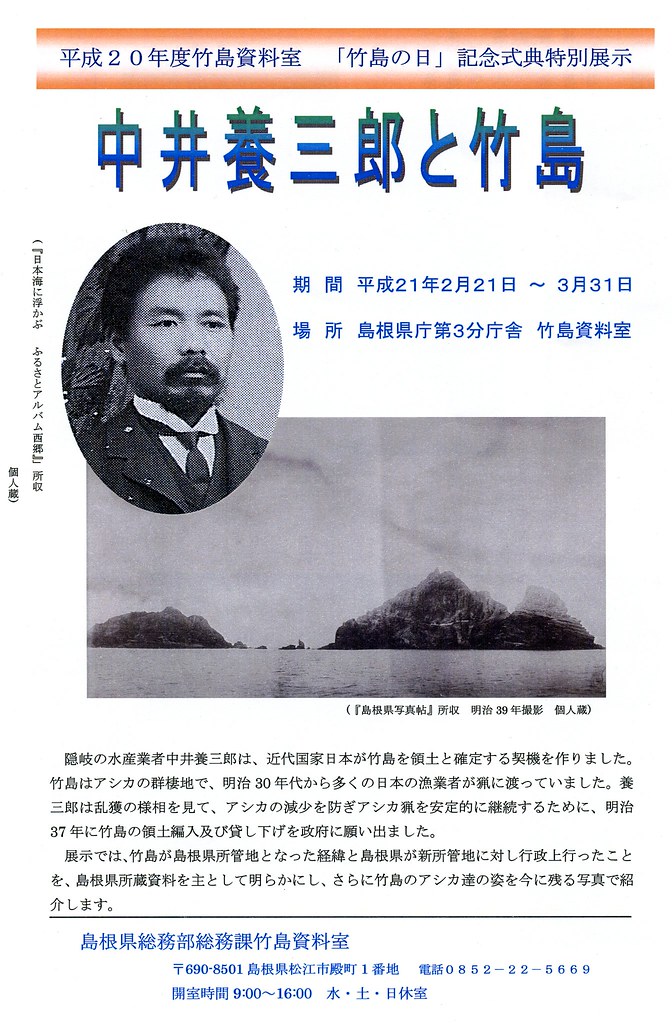
Exhibition on Nakai Yozaburo in Oki from 6/13 - 6/28

.
.
.
.A special exhibition on Nakai Yozaburo (中井養三郞) is being held at the Oki Island Cultural Center (隱岐島文化會館) from June 13 to June 28. Mr. Nakai was the man who petitioned the Japanese government in September 1904 to formally incorporate Liancourt Rocks (Takeshima / Dokdo). You can read his petition HERE.

Link to Japanese Announcement of the Exhibition