Should Japanese boycott travel to the Korean island of Ulleungdo to protest South Korea's barring of Japanese lawmakers to the island?
( ) Yes
( ) No
( ) I don't know.blockquote>
4.8.11
Should Japanese Boycott Ulleungdo?
I have put up a new survey on the right-hand side of the blog that asks the following question:


Yonhap --"Dokdo ferry operator imposes ban on Japanese passengers"
According to an Aug. 3 Yonhap News article HERE, a South Korean operator of a regular ferry service to Ulleungdo and Dokdo has said that "all Japanese citizens" are indefinitely barred from taking its ferries from South Korean east coast city of Gangneung to Ulleungdo and Dokdo. The article says he is barring Japanese "in protest against Tokyo's latest territorical claims."
Excerpt
Excerpt
"Our decision is to protest against the Japanese lawmakers' attempt to visit Ulleung Island earlier this week," said an official of Seaspovill Co., referring to the East Sea island located some 90 kilometers west of Dokdo. "It is in line with the government's will to sternly respond to the Japanese (government's) renewed assertion."This may just be a marketing ploy to get more Korean customers since there are other ferries serving the same route.
...
"Any Japanese passengers will not be allowed to board our ferries starting today," according to the official. "We will not scrap the decision until Japan stops making its absurd claims."
1.8.11
Japanese Politicians Stopped from Leaving Korean Airport
Three Japanese lawmakers arrived in Seoul, South Korea on the morning of August 1, but were denied entry into the country at Seoul's Gimpo International Airport because the Korean government claimed it could not guarantee their safety.
The three lawmakers wanted to visit the Dokdo Museum on Ulleungdo, which showcases maps and documents that supposedly support Korea's claim to Takeshima (Dokdo), a small group of rocky islets that is claimed by both Japan and Korea. The Korean president, himself, ordered that the Japanese lawmakers be denied entry to Korea ("Lee Wants Japanese Lawmakers Barred from Dokdo Mission").
Even Japanese Professor Shimojo Masao, who studies the history of the disputed islets, was denied entry to Korea on Sunday (July 31) even though he was not on the list of those banned from entry. According to this article, "Right-wing Japanese prof. heading to Ulleung Island denied entry to S. Korea", he was denied entry "due to the local Justice Ministry's disapproval of his visit."
I have read that Professor Shimojo has a Korean wife and property in South Korea. Is anyone who disagrees with Korea's historical claim to Takeshima a "right-winger" and banned from Korea?
It is very possible that the Japanese lawmakers would have been attacked by ultra-nationalist Koreans, but the Korean government and some of her politicians helped to incite the fanatics with hysterical rhetoric that claimed the Japanese were coming to Korea to "deny Korea's constitutional order" and "to pounce on Korean territory."


The photo to the left shows Korean protesters throwing salt and red pepper powder up into the air near the arrival gate inside the Korean airport while airport security stand by and watch.
Why would Koreans not want Japanese lawmakers visiting the Dokdo Museum on Ulleungdo since it supposedly has evidence to prove Korea's claim to Takeshima (Dokdo)?
The answer is that the museum does not have evidence to prove Korea's claims. It is essentially a propaganda facility designed to brainwash Korean school children and ignorant Korean tourists. The Korean government most probably did not want Japanese lawmakers seeing the distorted history and exhibits in the museum, fearing that they would return to Japan and expose the distortions and fabrications.
HERE is just one example of how the museum uses distorted models to try to support its false historical claim to Takeshima (Dokdo).
The Japanese lawmakers were denied entry to Korea because it was feared they would expose the lies of the Dokdo Museum.
Japan Probe has a great article on the story HERE.
The following is a Japanese language report of statements made by the Japanese lawmakers at the airport:
30.7.11
"Korea bans entry of Japanese reps on Ulleung foray"
Korea's Joongang Daily is reporting HERE that Seoul has informed Tokyo that it would ban from entering Korea four Japanese lawmakers planning to visit the Korean island of Ulleungdo and the Dokdo Museum there.
The Korean government said that it was banning the lawmakers because it would be "difficult to guarantee their safety and out of consideration of the influence on bilateral relations." However, I think the real reason for banning the Japanese is that the Korean government knows that the Dokdo Museum is a sham promoting distorted history to which the Korean government does not want the Japanese drawing international attention.
The Korean government said that it was banning the lawmakers because it would be "difficult to guarantee their safety and out of consideration of the influence on bilateral relations." However, I think the real reason for banning the Japanese is that the Korean government knows that the Dokdo Museum is a sham promoting distorted history to which the Korean government does not want the Japanese drawing international attention.
27.7.11
Should Japanese Lawmakers Be Barred from Visiting Dokdo Museum?
I have put up a new survey on the right side of the blog that asks the following question:
Should Japanese lawmakers be barred from visiting Dokdo Museum?Please let me know how you feel.
( )Yes
( ) No
( ) I don't know.
Korean President Bars Japanese Lawmakers from Korea
 South Korean President Lee Myung-bak has instructed his government to bar a group of Japanese lawmakers from entering Korea because they wish to visit the Korean island of Ulleungdo and the Dokdo Museum, which is a museum on the island that showcases maps and documents that Koreans say support their claim to Liancourt Rocks, which are called "Dokdo" in Korea and "Takeshima" in Japan. Both Korea and Japan claim sovereignty over the Rocks.
Why would it be dangerous for Japanese lawmakers to visit a Korean museum, and how does it "deny Korea's constitutional order"? Why would Korean authorities not want Japanese lawmakers to visit a museum that purportedly showcases evidence that supports Korea's historical claim to Liancourt Rocks?
The answer to all the above questions is that the Dokdo Museum is not an ordinary museum. It is an propaganda facility constructed to promulgate Korea's fabricated historical claims to Liancourt Rocks. Several of the exhibits there are distorted, childish models designed to brainwash school children and ignorant tourists, not Japanese lawmakers who are familiar with the history. It is pretty obvious that the real reason the Seoul government does not want the Japanese lawmakers visiting the Dokdo museum is that it fears the lawmakers will return to Japan afterwards and expose the blatant historical distortions being promulgated there.
Headlines should read as follows:
"Japanese Lawmakers Denied Entry to Korea for Wanting to Visit Korean Museum"
24.7.11
Why are Koreans afraid of Japanese lawmakers visiting Ulleungdo?
 Japanese lawmakers plan to visit the Korean island of Ulleungdo, where they also plan to visit the Dokdo Museum, a museum dedicated to spreading Korea's false territorial claims to the Japanese islets of Takeshima, which Koreans call Dokdo. Koreans have illegally occupied Takeshima since the 1950s, beginning soon after the 1951 Peace Treaty recognized the islets as Japanese territory.
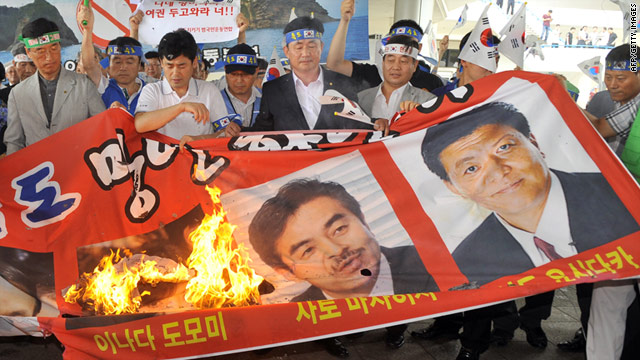
In the photo to the left, Korean protestors rip up a portraint of one of the Japanese lawmakers planning to visit the museum during a rally near the Japanese Embassy in Seoul. LINK
I think the reason Koreans are opposed to Japanese lawmakers visiting the museum is that they fear the lawmakers will expose some of the distortions and outrageous claims made at the museum, which is more of a propaganda facility than a real museum. The Korean government seems to be embarrassed by the museum. If Seoul were proud of the museum, then wouldn't the Korean government be encouraging the Japanese to visit the museum rather than discouraging them?
Probably one of the more infamous examples of the distortions at the Dokdo museum is an altered model of a 1530 Korean map. In the original map, an island labeled Usando (于山島 - 우산도) appears off the west coast of Ulleungdo (鬱陵島 - 울릉도), but in the model at the museum, Usando appears off the east coast of Ulleungdo. Koreans claim that Usando was the old name for "Dokdo," but Dokdo is off the east coast of Ulleungdo, so the museum staff apparently switched the location of the island on the model to better support their claim.
A copy of the original map and the altered model at the museum appear below:


20.7.11
"Seoul in Quanary Over Japanese Lawmakers" Planned Visit to Dokdo Museum
In a 19 July 2011 online article entitled "Seoul in Quandary Over Japanese Lawmakers' Dokdo Mission," the Chosun Ilbo reports that "Korean lawmakers were up in arms" on hearing that lawmakers from Japan's Liberal Democratic Party plan to visit Ulleungdo and the "Dokdo Museum" during their visit to Korea next month. The following is an excerpt from the article:
Japanese media reported Friday that the LDP lawmakers plan to visit Korea on Aug. 1-4. They want to meet Korean lawmakers on Aug. 1 and board a ferry to Ulleung the next day, where they plan to spend the night and visit the Dokdo Museum.Doesn't the Dokdo Museum supposedly have evidence that supports Korea's territorial claim over Dokdo? Is seems Korean lawmakers would want Japanese lawmakers to visit the place.
Korean lawmakers were up in arms. Special Affairs Minister Lee Jae-oh tweeted, "If their visit aims at supporting their country's groundless territorial claim on Dokdo, it's tantamount to encroachment of Korea's sovereignty. I will use all means to stop them landing on the island."
15.7.11
1906 - July 13 - "Daehan Maeil Shinbo" reports on Japanese Resident General Ikeda's Request for Information on Uldo County

池田公函
統監府通信管理局長池田十三郎氏가江原道三陟郡으로부터分設한鬱島郡面名洞号와設置何年月을昭詳録交하라고内部에公函하얏다더라
----------------------------------------
Ikeda’s Official Letter
Mr. Ikeda Juzaburo(池田十三郎), chief of the Administrative Bureau of Communications of the Japanese Resident-General, sent Korean Ministry of Interior an official letter of inquiry, asking for the clarification of the names of towns and titles of villages and the year/month of establishment of Uldo County, which was branched out of Samcheok County, Gangwon-do.
----------------------------------------
池田公文書簡
統監府通信管理局長池田十三郎氏が江原道三陟郡から分設した鬱島郡の面の名や洞・号と設置の年月を回答せよと内務部に公文を送ったとのこと。
Note that article says Mr. Ikeda asked about the towns and villages of “Uldo County”, not “Ulleung Island”. As we have already found, the article in the Korean newspaper, Hwangseong Shinmun (皇城新聞) on a same day reported that the Korean ministry replied that the county was established on October 25, 1900, and that the neighboring islands were Jukdo (竹島) and Seokdo (石島), or rocky island Jukdo (竹島石島). The Korean ministry also gave the dimensions of Ulleungdo as sixty ri from east to west and forty ri from north to south for a total of 200 ri. This left “Dokdo” outside of the County, meaning Korean government set Takeshima/Dokdo outside of their territory.
Pro-Korean claim that this dimension is for the solo island of Ulleungdo, not Uldo County, however, it is extremely unnatural to answer the area/dimension of sole island when you are asked about the Uldo County. Moreover, it almost coincides with the areas given by Lee Geon-ha(李乾夏), a Minister of Internal Affairs of Korea, who submitted the petition for the ordinance in the Imperial Edict which made Ulleungdo a County of Gangwon Province (大韓勅令第41号) in 1900. It is apparent that Korean government at the time didn’t even hint that they considered Seokdo(石島) in this Edict was today’s Dokdo(独島) as they suddenly started to claim around 1969.
When Korean central government finally received the report from Gangwon Province governor and Chunchon county magistrate Lee Myung-rae (江原道觀察署理・春川郡守 李明來), who originally received the report about "Dokdo", which locates 40km in the open sea(外洋百余里) away from Ulleungdo, becoming Japanese territory from the county magistrate Shim Heung-taek(沈興沢), Minister of Interior Lee Jee-yong(内部大臣 李址鎔) and Prime Minister Bak Che-soon (議政府参政大臣・朴齋純) ordered governor Lee to investigate the "circumamstances of the island in concern and the activity of Japanese on the island" by the "Directive no. III (指令第三号)" on 20th May.
If Korean government found out that Shim’s “Dokdo” was appended island of Ulleungdo and “Seokdo” in Ordinance 41 in 1900 was another name of the island, they must have answered “竹島独島(JukdoDokdo)”, instead of “竹島石島(JukdoSeokdo)”, in the reply letter to the Resident-General, who asked about the towns and villages of “Uldo County”, not “Ulleung Island”.
From those articles, it is apparent that Korean government then didn’t consider Dokdo/Takeshima as their territory, and technically, that means they officially acquiesced the Japan's sovereignty over Takeshima/Dokdo by not interpolating "Dokdo" in the answer to claim the sovereignty.
chaamiey helped me for translating the article and corrected my mistakes. Two hanguls which are not used today were replaced by 한 and 하 by his advice. Thak you, chaamiey.
Related posts;
1899 - Sep 23 - "Hwangseong Sinmun" (皇城新聞) 1899 Sep 23: Ulleungdo Situation
1900 - "Uldo-gi" (鬱島記), by U Yong-jeong (禹用鼎)
1900 - Oct. 22 - A petition by 李乾夏 "鬱陵島를鬱島로改稱하고島監을郡守로改正에關한請議書", which excluded Dokdo from Uldo County.
1900 - Imperial Edict Makes Ulleungdo a County of Gangwon Province (大韓勅令第41号)
1906 - Feb 20 & April 17 - "Official Documents of the Ministry of Internal Affairs Vol.1" - Korean government protested about land transaction in 竹邊浦
1906 - July - Korea Omits Dokdo from Uldo County (皇城新聞 「鬱島郡의 配置顛末」)
1906 - Apr 1 - Japanese Tell Koreans of Takeshima Incorporation (山陰新報 "竹島土産")
1906 - Apr 8 - "Diary of My Trip to Takeshima" # 3 (山陰新報 "竹嶋渡海日記")
1906 - Sep 26 - Boundary Survey of Uldo County Conducted (皇城新聞 "鬱島戸口")
1913 - June 22- Location of Usando Unknown in Early 1900s (毎日申報 "無人島探検中止")
29.6.11
1906 - July - the Korean Self-Strengthening Society (大韓自强會) blotted out Takeshima/Dokdo from its monthly magazine in 1906.
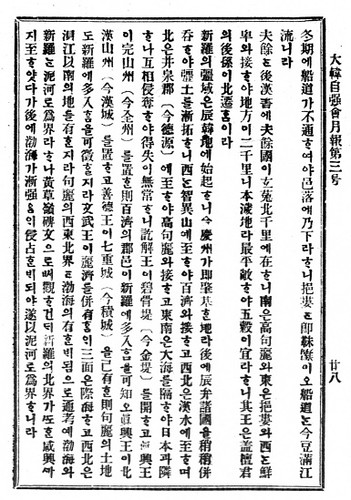
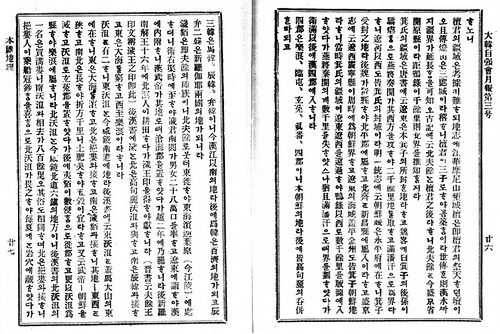
 In 1906, one of the leading organizations of Patriotic Enlightenment Movement for the restoration of the sovereign right of the nation, “the Korean Self-Strengthening Society (大韓自强會)”, was founded by Jang Ji-yun(張志淵) and others. They published 13 edition of monthly magazines from July 1906 to July 1907. Interestingly, the front pages of those magazines are same and features Korean territory in red, blotting out Takeshima/Dokdo from her territory.
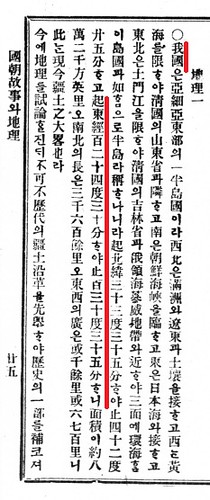
Moreover, the chapter of the Korean geography printed in the 3rd edition of the magazine published on July, 1906, clearly states that the eastern limit of Korean territory is 130º 35' E. longitude.
Remember that Jang Ji-yun was the president, the publisher and the editor in chief of Hwangseong Shinmun(皇城新聞). Its May 9 1906 article reported that 1906, Mar. 25, Uldo Prefect Governor Shim Hung-taek(沈興澤) reported that Japanese incorporated “Dokdo(獨島)” (note that he didn’t report Seokdo/石島) which locate "外洋百里(40km far in the open sea). And in a July 13, 1906 article clarified that the Korean government in 1906 did not recognize "Dokdo" (Liancourt Rocks) as being part of Uldo County (Ulleungdo), even though the government had just recently gotten a report on "Dokdo" from Shim.
This coincide with this Korean Self-Strengthening Society’s monthly magazine cover illustration of Korean Territory. It is crystal clear that Korean didn’t recognize Takeshima/Dokdo as its territory, at the time Korean got to know Japan’s incorporation in 1906. Apparently, Shim’s report was mistake and “獨島” was not “石島”, which today’s Korean claim as another name of Dokdo back then. In conclusion, 石島 in 1900’s Korean Imperial Edict No.41 (大韓勅令第41号) was not Japan’s Takeshima and Korean didn’t recognize Takeshima as its territory based on Korea’s own historical documents.
In 1907, Jang published "New Topography of Great Korea(大韓新地誌)". Its chapter of "location" states that Korea's eastern border is Tumen River and it is 130º 58' E. longitude. As for Ulleungdo, Jan wrote, that Uleung Island locates from 130º 45' N. to (130º) 35' N. and from 37º 34' E. to (37º) 31' E. (Probably the mistake for 130º 45' E. to (130º) 53' E. and from 37º 34' N. to (37º) 31' N. ) The states that Uleung island can be seen (from Korean peninsula) on a clear fine day. It also says that Usando exists to the south-east of the island. However, the map attached to the book also blotted out Takeshima/Dokdo from its "The Map of Korea(大韓全図)" and "The Map of Gyeongsangbuk-do(慶尚北道)" as well. On top of that, "The Map of Gyeongsangbuk-do(慶尚北道)" depicts Jukdo(竹島, not Japan's Takeshima) precisely on the location of Jukdo. From those historical documents, whatever the Usando Jan added really was, it is apparent that he considered Korea's easternmost was Ulleungdo and today's Takeshima/Dokdo was outside of Korean territory.
"The attatched map of The New Topography of the Great Korea (大韓新地志附地圖)" (The National Library of Korea's site)
20.6.11
Which country will China try to occupy first, Taiwan or North Korea?
I have put up a new survey question on the right side of the blog that it is unrelated to the Takeshima-Dokdo dispute. The question is as follows:
Which country will China try to occupy first, Taiwan or North Korea?I apologize for the question being unrelated to the Takeshima-Dokdo dispute, but I have my reasons for asking it.
- Taiwan
- North Korea
- Neither
- Both at the same time
10.6.11
The Reason Japan Cannot Give Up Takeshima (Dokdo)
In a somewhat meandering article entitled, "A Korea-Japan alliance?" Peter M. Beck, who is supposedly a Research Fellow at Keio University in Tokyo, suggests that Japan's refusal to give up her "hopeless" claim to "Dokdo" is hurting the chances of creating a Korea-Japan alliance that could help counter an increasingly belligerent China and North Korea. Moreover, he believes that by giving up its claim to "Dokdo," Japan would receive "a flood of Korean goodwill."
I see three problems with the logic Mr. Beck uses in his attempt to entice Japanese to give up their claim to "Dokdo," and one of them is a really big one.
First, "Dokdo," which is called "Takeshima" by the Japanese, is just a small cluster of barren rocks in the middle of the Sea of Japan with no real economic or strategic importance, which means a territorial dispute over such insignificant rocks should not be an obstacle to forming an alliance between Korea and Japan. It is not Japan that considers the rocks an obstacle; it is Korea, even though Korea occupies the rocks. Therefore, if Korea is willing to put such insignificant rocks ahead of an alliance with Japan, then that is evidence that the alliance would not really be worth much.
Second, I think any Korean goodwill that Japan would receive by giving up her claim to Takeshima would be only temporary. Koreans would soon find other reasons for withholding their "goodwill." Therefore, giving up her claim to Takeshima would not really benefit Japan in the long run, unless she could get something more tangible in exchange,
Last, the biggest reason Japan cannot, and should not, give up her claim to Takeshima is that it would mean, in effect, accepting Korea's historical claims to Takeshima, which are essentially nothing but lies. Historically, Takeshima was never Korean territory, so until Korea recants her lies about Takeshima, Japan has an obligation to History to continue to maintain her claim to the barren rocks.
UPDATE:
Mr. Peter M. Beck has responded HERE to my comment about his article, which I have linked to above. The following is how I responded to his comment.
Mr Beck,
I did not focus on “Korean lies” in my above response to your article. I focused on your flawed logic, which, by the way, was shown again in your statement, “My views cannot be too flawed or biased as a major Japanese newspaper has asked me to write a version for them!”
There is nothing ambiguous about the fact that Japan, in 1905, incorporated Takeshima (Liancourt Rocks), which you chose to refer to by its Korean name, “Dokdo.”
The fact that you have asked me “to explain why several official Meji maps indicate the rocks as being Korean” tells me that you do not really understand the history of the Rocks or the map confusion of the 1800s, which was caused by the mismapping of the Korean island of Ulleungdo by the British ship “Argonaut.”
Korea has no old maps showing Liancourt Rocks (Dokdo) by any name or any documents showing that Koreans ever claimed or even visited the Rocks before the Japanese starting taking them there as deckhands on Japanese fishing boats in the early 1900s. In fact, the Rocks are only mentioned about three times in Korean history as being a distant, unnamed island visible from Ulleungdo, and each time it was referred to as being Japanese territory or suggested as being Japanese territory.
Let me say, again. There is no evidence that Korea ever claimed Liancourt Rocks before Japan incorporated them in 1905, and there is no evidence that Japan ever recognized any imaginary Korean claim to the Rocks.
Even without knowing which of the “several official Meiji maps” you are referring to, I can say pretty confidently that none of them recognized Liancourt Rocks (Dokdo) as Korean territory. Are these “official” Meiji maps the only evidence you have to claim that the Rocks were Korean?
I see three problems with the logic Mr. Beck uses in his attempt to entice Japanese to give up their claim to "Dokdo," and one of them is a really big one.
First, "Dokdo," which is called "Takeshima" by the Japanese, is just a small cluster of barren rocks in the middle of the Sea of Japan with no real economic or strategic importance, which means a territorial dispute over such insignificant rocks should not be an obstacle to forming an alliance between Korea and Japan. It is not Japan that considers the rocks an obstacle; it is Korea, even though Korea occupies the rocks. Therefore, if Korea is willing to put such insignificant rocks ahead of an alliance with Japan, then that is evidence that the alliance would not really be worth much.
Second, I think any Korean goodwill that Japan would receive by giving up her claim to Takeshima would be only temporary. Koreans would soon find other reasons for withholding their "goodwill." Therefore, giving up her claim to Takeshima would not really benefit Japan in the long run, unless she could get something more tangible in exchange,
Last, the biggest reason Japan cannot, and should not, give up her claim to Takeshima is that it would mean, in effect, accepting Korea's historical claims to Takeshima, which are essentially nothing but lies. Historically, Takeshima was never Korean territory, so until Korea recants her lies about Takeshima, Japan has an obligation to History to continue to maintain her claim to the barren rocks.
UPDATE:
Mr. Peter M. Beck has responded HERE to my comment about his article, which I have linked to above. The following is how I responded to his comment.
Mr Beck,
I did not focus on “Korean lies” in my above response to your article. I focused on your flawed logic, which, by the way, was shown again in your statement, “My views cannot be too flawed or biased as a major Japanese newspaper has asked me to write a version for them!”
There is nothing ambiguous about the fact that Japan, in 1905, incorporated Takeshima (Liancourt Rocks), which you chose to refer to by its Korean name, “Dokdo.”
The fact that you have asked me “to explain why several official Meji maps indicate the rocks as being Korean” tells me that you do not really understand the history of the Rocks or the map confusion of the 1800s, which was caused by the mismapping of the Korean island of Ulleungdo by the British ship “Argonaut.”
Korea has no old maps showing Liancourt Rocks (Dokdo) by any name or any documents showing that Koreans ever claimed or even visited the Rocks before the Japanese starting taking them there as deckhands on Japanese fishing boats in the early 1900s. In fact, the Rocks are only mentioned about three times in Korean history as being a distant, unnamed island visible from Ulleungdo, and each time it was referred to as being Japanese territory or suggested as being Japanese territory.
Let me say, again. There is no evidence that Korea ever claimed Liancourt Rocks before Japan incorporated them in 1905, and there is no evidence that Japan ever recognized any imaginary Korean claim to the Rocks.
Even without knowing which of the “several official Meiji maps” you are referring to, I can say pretty confidently that none of them recognized Liancourt Rocks (Dokdo) as Korean territory. Are these “official” Meiji maps the only evidence you have to claim that the Rocks were Korean?
6.6.11
Why Did Koreans Fail to Mention Imperial Edict #41 to the US in 1951?
The following is a very well written and reasoned explanation in Korean for why Korea failed to use the 1900 Imperial Edict # 41 argument with US authorities in their failed attempt to get the US to recognize Liancourt Rocks (Dokdo) as Korean territory in the 1951 Treaty of Peace with Japan. The following Korean explanation can be found at this site:
I do not know who runs the site, but he writes Korean quite fluently.
독도 문제의 진실 獨島問題의真實
I do not know who runs the site, but he writes Korean quite fluently.
제2차 세계대전 이후의 일본 영토 범위는 샌프란시스코 강화 조약에 의해서 결정되었습니다. 그 조약의 최종 초안에서는 다케시마/독도는 일본의 영토라고 정해졌습니다. 그것을 알게 된 한국 정부는 양유찬(梁裕燦) 주미 한국 대사를 통해서 1951년7월19일차 문서로 독도를 한국의 영토에 넣어달라고 요청하는 문서를 미국 정부에 제출했습니다. 이것에 대해서 미국 정부는 1951년8월10 일차 이른바 러스크 서간을 통해서 한국 정부의 요청을 거부했습니다. 이것은 유명한 사실이기 때문에 여러분 다 알고 있겠지요.
그런데, 양유찬 대사는 미국에 대해서 독도를 한국의 영토에 넣어달라고 요청할 때, 그 근거로서 1900년 대한제국 황제 칙령 제41호를 주장하지 않았습니다. 왜 주장하지 않았을까요?
현대 한국 정부는 칙령 제41호에 규정된 석도(石島)가 독도이며 대한제국은 1900년에 독도가 한국 영토임을 세계에 선언했다고 주장하고 있습니다. 칙령 제41호는 한국이 독도 영유권을 주장하기 위한 중요한 근거인 것 같습니다. 그것이 사실이라면, 미국 정부에 대해서 제대로 설명하면 미국 정부도 고려했을 것이었습니다. 하지만 양 대사는 칙령 제 41호에 대해 언급하지 않았군요. 왜 언급 하지 않았을까요?
그 이유는 명백합니다.사실 칙령 제41호에 규정된 석도는 독도가 아니기 때문입니다. 당시 한국 정부는 칙령 제41호에 규정된 석도는 독도가 아니기를 잘 알고 있었습니다. 따라서 미국 정부에 대해서 거짓말을 할 수 없었습니다.
현대 한국 정부도 입에서는 칙령 제41호에 규정된 석도가 독도이라고 주장 합니다만, 석도에 관한 구체적인 지도나 문서를 전혀 제시 못하고 있습니다. 그러한 자료는 거의 없기 때문이지요.
한국 사람 들은 다케시마/독도를 불법점거 하고 있음을 속이려고 하는 정부의 허위 주장을 언제까지 믿습니까? 한국의 선진화를 위해서는 진실을 보는 눈이 필요합니다.
2.6.11
Arirang: "Korean Lawmakers Hold Seminar of Dokdo"
According to a June 1 article from Arirang News HERE, Korean lawmakers seem worried that Japan's historical claims to Liancourt Rocks (Takeshima - Dokdo) are stronger than theirs, so they will try to "look at the evidence as a whole rather than trying to refute the part on which Japan bases its claims." That sounds like instead of trying to refute Japanese claims to Liancourt Rocks, which they seem unable to do, they will try to obfuscate and confound the debate.
Korean Lawmakers Hold SEminar on Dokdo
Korean lawmakers from the ruling and opposition parties gathered at the National Assembly on Wednesday for a seminar on Korea's Dokdo Islets in the East Sea.
Their objective was to deliver and discuss facts on the islets re-confirming Korea's control since historical times in a scholarly manner, with college professors, an international law judge and researchers.
[Interview : Park Sun-young, Co-chair
Assoc. of Lawmakers for Dokdo] "We, the Korean people care deeply about Dokdo, but we do not have good research that documents our territorial rights to the islets. In contrast, Japan has conducted many research projects to make an argument claiming Dokdo as theirs. We are in need of finding the best way to refute and react to these well prepared, but false claims from Japan. So we arranged for this seminar."
The discussants presented supporting documents dating as far back as the fourth century that show Dokdo belonging to ancient Korean kingdoms, which is some 11-hundred years earlier than the records used by Japan.
[Interview : Yuji Hosaka, Director
Dokdo Institute of Sejong University] "Japan's claims on Dokdo begin with a basis on historical truth, but end with many false facts. In other words, many of Japan's claims on the islets as a whole are unfounded. So we need to expose these false arguments. And to do so we should look at the evidence as a whole rather than trying to refute from the part on which Japan bases its claims. This is what we need at this point."
The advice by Professor Yuji Hosaka, a Japanese immigrant who is now a naturalized Korean citizen, was well received by the panel.
They also agreed on the need to hold more meetings to make Korea's claim on Dokdo consistent and strong.
[Reporter : Kang Seok-ho ed:mark
kangsh@arirang.co.kr] "Firmly united in their will to protect the islets from continued claims from Japan, Korean lawmakers from all sides of political spectrum will keep working to inform the world that the Dokdo Islets belong to Korea.
Kang Seok-ho, Arirang News."
JUN 01, 2011
Reporter : kangsh@arirangtv.com
Subscribe to:
Posts (Atom)