竹島問題の歴史

18.8.11

The Diplomat: "Why Dokdo Matters to Korea"

The Diplomat, which describes itself as "the premier international current-affairs magazine for the Asia-Pacific region," has posted an online article entitled "Why Dokdo Matters to Korea." I did not like some of the things said in the article, so I wrote the below comment.

One of the  claims in the article is that the Japanese lawmakers who were denied entry to Korea a couple of weeks ago were "attempting to visit the disputed islands of Dokdo/Takeshima." Another is that "Japan’s annexation of the islands [Dokdo/Takeshima] was among the first in a series of actions that led to the colonization of the peninsula."

Here is how I responded to the article, though it includes a few corrections to mistakes I found in my comment after it was posted:
There are many problems with this article.

First, the Japanese lawmarkers did not go to Korea to visit “Dokdo” (Takeshima). They went there to visit the Dokdo Museum on the Korean island of Ulleungdo, which is about ninety kilometers northwest of “Dokdo.” The museum houses maps and documents that Koreans say support their claim to “Dokdo.” The Japanese stated that they had no intention of visiting the disputed islets.

Second, Korea refuses to take the dispute to the International Court of Justice (ICJ) not because Koreans have some “powerful historical memory” of Japanese colonial rule, but because Korea has no maps or documents to support any historical claim to “Dokdo.” In other words, Korea knows the ICJ would rule against her.

The reason Korea has no maps or documents is that her claims were all fabricated shortly after World War II with the hope that she would be able to gain Japanese territory, which included not only “Dokdo” but also the Japanese island of Tsushima. The United States, however, rejected Korea’s claims. In an August 9, 1951 letter to the Korean ambassador, US Secretary of State Dean Rusk wrote the following.
“As regards the island of Dokdo, otherwise known as Takeshima or Liancourt Rocks, this normally uninhabited rock formation was according to our information never treated as part of Korea and, since about 1905, has been under the jurisdiciton of the Oki Islands Branch of Shimane Prefecture of Japan. The island does not appear ever before to have been claimed by Korea….”
Korea never even attempted to provide the US with evidence to support her claim. Instead, Korean President Syngman Rhee simply declared “Dokdo” Korean territory after the 1951 Treaty of Peace with Japan, which allowed Japan to keep the island.
After visiting the Far East in 1954, US Special Mission Ambassador James Van Fleet wrote the following in his post-mission report:
"The Island of Dokto (otherwise called Liancourt and Take Shima) is in the Sea of Japan approximately midway between Korea and Honshu (131.80E, 36.20N). This Island is, in fact, only a group of barren, uninhabited rocks. When the Treaty of Peace with Japan was being drafted, the Republic of Korea asserted its claims to Dokto but the United States concluded that they remained under Japanese sovereignty and the Island was not included among the Islands that Japan released from its ownership under the Peace Treaty. The Republic of Korea has been confidentially informed of the United States position regarding the islands but our position has not been made public. Though the United States considers that the islands are Japanese territory, we have declined to interfere in the dispute. Our position has been that the dispute might properly be referred to the International Court of Justice and this suggestion has been informally conveyed to the Republic of Korea."
While Korea has no old maps showing “Dokdo,” by any name, or any documents showing that Koreans ever visited the islets before the Japanese started taking them there as deckhands on Japanese fishing boats in the early 1900s, Japan has maps of the islets dating back to the 1600s and documents clearly describing them. Also, Japan officially incorporated “Takeshima” (Dokdo) into Shimane Prefecture in February 1905, after receiving a 1904 request to do so by a Japanese fisherman who was using the islets to capture and process sea lions.

The incorporation of Takeshima had nothing to do with the colonization of Korea. The islets were just a small group of rocks that had little or no strategic value and were not a part of Korea, so it is wrong for the writers of the article to write that “Japan’s annexation of the islands was among the first in a series of actions that led to the colonization of the peninsula.”
Korean “outrage” over Japanese claims to “Dokdo” is the result of about sixty years of fabricated Korean propaganda. It is not Japan who refuses to discuss the issues in the dispute; it is Korea. To solve the problem, Korean historians need to start telling the truth about the history of “Dokdo.”

15.8.11

1955 - “Introduction to Dokdo Issue (獨島問題概論)” - ROK Government Blotted out Rusk Note to hide the truth from its own Diplomats.

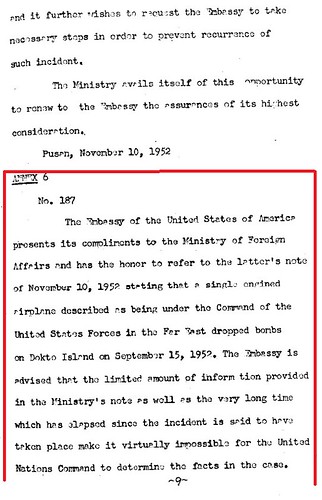
In 1955, ROK Minisitry of Foreign Affairs published the book titled “Introduction to Dokdo Issue (独島問題概論)”. The purpose of this book is, according to the preface written by KIm Dong-Jo(金東祚), a Minister of Foreign Affairs of ROK, to help Korean diplomats’ at overseas agencies of the Ministry of Foreign Affairs aquire better understandings on Dokdo Issue. However, the “American Embassy’s Note Verbale No.187” which dates on 4th Dec. 1952 attached in the 6th of “ANNEX” section of the book had crucial flaw for better understanding of the Issue.

“Introduction to Dokdo Issue (獨島問題概論)”(1955)


ANNEX 6

No. 187

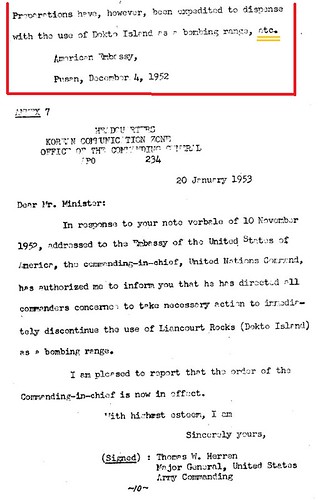
The Embassy of the United States of America presents its compliments to the Ministry of Foreign Affairs and has the honor to refer to the latter’s note of November 10,1952 stating that a single engine airplane described as being under the Command of the United States Forces in the Far East dropped bombs on Dokto Island on September 15, 1952. The embassy is advised that the limited amount of information provided in the Ministry’s note as well as the very long time which has elapsed since the incident is said to have taken place make it virtually impossible for the United Nations Command to determine the facts in the case. Preparations have, however, been expedited to dispense with the use of Dokto island as a bombing range, etc.


American Embassy,

Pusan, December 4, 1952


Note that it ends with “etc”. If you see other documents in the Annex, they add “etc” for the section they omitted mainly because it has not direct relationship with the Issue of Dokdo/Takeshima. However, As was shown in the previous post, original American official Note No.187 dated on 4th Dec. 1952 had contained the part of notification of Rusk Note following the bombing matter and it clearly denied ROK claim on Dokdo and warned her that U.S. considered Takeshima/Dokdo is Japanese territory. ROK government apparently blotted out to conceal the fact that their claim on Dokdo had been already rejected by U.S. , leaving the islets to Japan, from its own diplomats. Check the original document below.

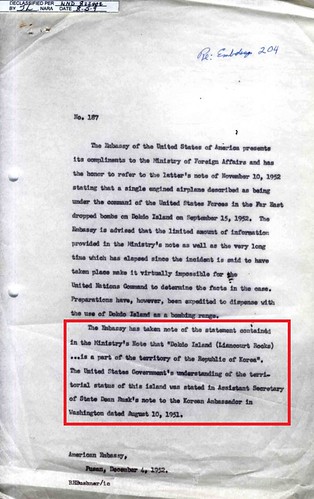
“American Embassy’s Note Verbale No.187” dates on 4th Dec. 1952.


No. 187

The Embassy of the United States of America presents its compliments to the Ministry of Foreign Affairs and has the honor to refer to the latter’s note of November 10,1952 stating that a single engine airplane described as being under the Command of the United States Forces in the Far East dropped bombs on Dokto Island on September 15, 1952. The embassy is advised that the limited amount of information provided in the Ministry’s note as well as the very long time which has elapsed since the incident is said to have taken place make it virtually impossible for the United Nations Command to determine the facts in the case. Preparations have, however, been expedited to dispense with the use of Dokto island as a bombing range.

The Embassy has taken note of the statement contained in the Ministry's Note that "Dokdo Island(Liancourt Rocks)...is a part of the territory of the Republic of Korea". The United States Government's understanding of the territorial status of this islands was stated in Assistant Secretary of State Dean Rusk's note to the Korean Ambassador in Washington dated August 10, 1951.


American Embassy,

Pusan, December 4, 1952


As has told in the previous post, ROK government used the fact that U.S.’s suspension of the bombing on Liancourt Rocks after Korean fishermen/women were almost killed on 15th September, 1952. The document was thus included in the book for the purpose to reinforce their logic. However, Takeshima was finally decided to be released from bombing range by the U.S. & Japan Joint Committee on 19 Mar., 1953, not Korea-U.S. Committee, because of the petition by Shimane Prefecture.

Although Rusk Note went to public on April 1978, even today, Korean government keeps telling lies, such as Usando is Dokdo’s old name, to its own people and never stops illegal occupation on Japanese islets. The only way for innocent Korean people to escape from deception by its own government is to see the first-hand historical documents and old maps which are available on this blog.

The original idea of this “discovery” was brought by yabutarou and the photocopies of the book was provided by matsu. It was discussed on this blog on January 2010.


1955 “The Introduction to Dokdo Issue (獨島問題概論)”(1955)_1 1955 “The Introduction to Dokdo Issue (獨島問題概論)”(1955)_2 1952 1204 American Embassy’s note verbale No.187, December 4, 1952_2

Related posts and links;

1946 - Jan 29 - SCAPIN 677
1946 - Feb 13 - "Conference with GHQ/SCAP concerning separation of the administration"
1946 - Jun 22 - SCAPIN 1033
1947 - Sep 16 -SCAPIN 1778
1949 - Nov 14 - Willam J. Sebald's telegram
1949 - U.S. Maps DOES NOT Confirm Korean Sovereignty Over Dokdo
1949 - Nov 14 - A letter from W. Walton Butterworth
1949 - Dec 29 - U.S. Draft made on December 29, 1949
1950 - July - Commentary on Draft Treaty by the Department of State
1950 - Aug 7 - U.S. Draft made on August 7, 1950
1950 - Oct 26 - USA Answers to Questions Submitted by the Australian Government
1951 - Apr - May: Joint UK and USA Draft - extra(1)
1951 - Jun 1 - New Zealand's view - extra(2)
1951 - Jul 6 - SCAPIN 2160 (cache)
1951 - Jul 9 - Coversation of Yu Chan Yang with John F. Dulles
1951 - Jul 19 - The 2nd Conversation between Yu Chan Yang and John F. Dulles
1951 - Jul 26 - the Japan-U.S. Joint Committee designated Takeshima as a bombing range for the U.S. Forces stationed in Japan. (official gazette of Japan)
1951 - Aug 2 - Another letter from You Chan Yang
1951 - Aug 3 - Bogg’s Memorandum (On re-ceiving Boggs's memo. I asked the Korean desk to find out whether anyone in the Korean Embassy officer had told him they believed Dokdo was near Ullengdo, or Takeshima Rock, and suspected that Parangdo was too.)
1951 - Aug 9 - Rusk's Letter  ( As regards the island of Dokdo, otherwise known as Takeshima or Liancourt Rocks, this normally uninhabited rock formation was according to our information never treated as part of Korea and, since about 1905, has been under the jurisdiction of the Oki Islands Branch Office of Shimane Prefecture of Japan. The island does not appear ever before to have been claimed by Korea. )
1951 - Sep 9 - San Francisco Peace Treaty
1951 - Sep 21 - Korean Government comprehended Takeshima/Dokdo was affirmed as a Japanese Territory in Peace Treaty
1952- Jan 18 - Syngman Rhee Line
1950's - Japan & Korea Argue Their Claims in 1950s Letters
1952 - Jul 26 - The Japan-U.S. Joint Committee designated Takeshima as a bombing range for the U.S. Forces (The Ministry of Foreign Affairs published this fact in the official gazette.)
1952 - Nov 5 - Confidential Security Information of USA ("It appears that the Department has taken the position that these rocks belong to Japan and has so informed the Korean Ambassador in Washington." )
1952 - Dec 4 - Confidential Security Information of USA ( "I much appreciate your letter of November 14 in regard to the status of the Dokdo Island (Liancourt Rocks). The information you gave us had never been previously available to the Embassy. We had never heard of Deen Rusk’s letter to the Korean Ambassador in which the Department took a definite stand on this question.")
1952 - Dec 4 - “American Embassy’s Note Verbale No.187” - U.S. iterates Rusk Note to ROK.
(American Embassy in Busan gave South Korean Government an official notification that Takeshima is not Korean territory by reminding Dean Rusk’s Note on 9th August, 1951, which rejected Korea’s demand for Takeshima/Dokdo. )
1953 - Mar 19 - Japan U.S. Joint Committee decided to release Takeshima from the designation of a bombing range for the U.S. Forcese
1953 Jul 22 - Confidential Security Information of USA “Possible Methods of Resolving Liancourt Rocks Dispute between Japan and ROK”( The United States Government's understanding of the territorial status of this island was stated in assistant Secretary dated August 10,1951.")
1953 - Nov 30 - Secret Security Information of USA ("The Liancourt Rocks case appears to have aspects in common with that of Shikotan Island" "Remind the ROK of our previous statement of view (the Rusk letter)")
1953 - Dec 9 - SECRET SECURITY INFORMATION by Dulles
1953 - Jul 22 - US Doc. Reconfirms Dean Rusk Letter (Letter from Office of Northeast Asian Affairs To E. Allan Lightner American Embassy, Pusan Korea by L. Burmaster Office of U.S. Northeast Asian Affair )
1953 - Oct 13 - Daiichi-Daihou Maru Incident - the dispute over the Rhee Syngman Line
1954 - Aug - Report of Van Fleet mission to the Far East, 26 April - 7 August , 1954
2008 - Jul 30 - Press Briefing by Senior Director for Asian Affairs at the National Security Council, Dennis Wilder, on President's Trip to Asia (cache)

14.8.11

1952 - Dec. 4 - “American Embassy’s Note Verbale No.187” - U.S. iterates Rusk Note to ROK.

On 4th December 1952, American Embassy in Busan gave South Korean Government an official notification that Takeshima is not Korean territory by reminding Dean Rusk’s Note on 9th August, 1951, which rejected Korea’s demand for Takeshima/Dokdo.

No.187

The Embassy of the United States of America presents its compliments to the Ministry of Foreign Affairs and has the honor to refer to the latter's note of November 10, 1952 stating that a single engined airplane described as being under the command of the United States in the Far East dropped bombs on Dokdo Island on September 15, 1952. The Embassy is advised that the limited amount of information provided in the Ministry's note as well as the very long time which has elapsed since the incident is said to have taken place make it virtually impossible for the United Nations Command to determine the facts in the case. Preparations have, however, been expedited to dispense with the use of Dokdo Island as a bombing range.

The Embassy has taken note of the statement contained in the Ministry's Note that "Dokdo Island(Liancourt Rocks)...is a part of the territory of the Republic of Korea". The United States Government's understanding of the territorial status of this islands was stated in Assistant Secretary of State Dean Rusk's note to the Korean Ambassador in Washington dated August 10, 1951.


American Embassy,

Pusan, December 4, 1952


On 9th July 1951, Korean Government was formally declined it's greedy demands for Tsushima by Ambassador Dulles. Instead, she suddenly asked for Dokdo/Takeshima and even non-existent Parang-do on 19th, 1951. However, the 3rd August’s note inside American Governmen reveals that Mr. Boggs, long-time Geographer to the Department of State, couldn’t identify the location of Dokdo and Parang-do despite trying all resources in Washington, and neither did Korean Embassy. As a consequence, Assistant Secretary of State Dean Rusk officially denied Korea’s inordinate demand for Takeshima/Dokd on 9th 1951.

As regards the island of Dokdo, otherwise known as Takeshima or Liancourt Rocks, this normally uninhabited rock formation was according to our information never treated as part of Korea and, since about 1905, has been under the jurisdiction of the Oki Islands Branch Office of Shimane Prefecture of Japan. The island does not appear ever before to have been claimed by Korea. It is understood that the Korean Government's request that "Parangdo" be included among the islands named in the treaty as having been renounced by Japan has been withdrawn.


Korean Government didn’t offer a counterargument concerning the sovereignty of the islands before the Peace Treaty was signed on September 8, 1951. However, On Sep. 21st, 1951, ROK again claimed Dokdo/Takeshima based on SCAPIN-677 MacArthur line and U.S.’s apology to Korea for the victims of 1948 bombing incident. But American Embassy in Pusan laughed off ROK’s empty comment, “we have substantial documented evidence to prove that the isle has been in the Korean possession for many hundred years”, which they couldn’t present any. The series of denial by America cornered ROK and she weiled the big stick after she finally realized that Takeshima/Dokdo has formally left to Japan by San Francisco Peace Treaty. ROK suddenly set Rhee Line in open waters, enclosing Dokdo/Takeshima inside Korean side.

As was stated in the note, it was issued in the response to the ROK’s protest against the bombing incident happened on 15th Sep. Some 23 Korean fishermen and women divers fishing on Takeshima/Dokdo narrowly escaped from bombs dropped by the airplane which returned to the direction of Japan afterwards. Consequently, a “scholarly exploration” party by Korean government couldn’t reach to Takeshima. It is no wonder since SCAP and U.S. government considered Takeshima was Japanese territory and U.S. and Japan joint committee designated Takeshima as bombing range for U.S.Forces.

In July 1951, while Japan was still under Allied occupation, the Supreme Command for Allied Powers designated Takeshima as a bombing range for U.S. Forces by SCAPIN No. 2160. In July 1952, right after the San Francisco Peace Treaty came into effect, in response to the desire of the U.S. Forces to continue to use Takeshima as a training area, the Japan-U.S. Joint Committee established as the consultative body for the implementation of the Japan-U.S. Administrative Agreement (an agreement based on the former Japan-U.S. Security Treaty, which was succeeded by the current Japan-U.S. Status of Forces Agreement) designated Takeshima as a bombing range for the U.S. Forces stationed in Japan. The Ministry of Foreign Affairs published this fact in the official gazette. ( “Takeshima as a Bombing Range for U.S. Forces” by Japanese MOFA)


Despite the fact that the islands are within the danger zone, the government of ROK not only didn’t take necessary steps to protect its own people dissuading fishermen/women from collecting shells on the islands but also even sent government lead “scientific expedition” whose “intent has obviously been to establish claim to Korean sovereignty over the rocks”. The similar incident had once happened in the June 8 of 1948. About 20 Korean were killed by the American bombing. In other words, ROK government took precedence its territorial ambitions over the life of its own people.

Next year, U.S. government ceased bombing because of the “crude implementation of Government control in Korea” and the U.S. and Japan “Joint Committee decided to release Takeshima from the designation of a bombing range for the U.S. Forces in March 1953”. Although the decision was made not only because of the incident, but because of petition by local people from Shimane on 20th May, 1952., Korean government soon started to take advantages of this cession as one of the proof U.S. ‘s recognition Korea’s sovereignty on the rocks.

This note is very important since Mr. Dennis Wilder, a Senior Director for Asian Affairs at the National Security Council, officially told that U.S. policy on this territorial dispute has been firm and consistent since 1952 during the press briefing on President's trip to Asia on July 30, 2008. “Our position since 1952” apparently means the U.S. position described in this official Note to ROK.

This note No. 187 had been referred many times in other U.S. documents such as “Letter from E. Allan Lightner American Embassy, Pusan Korea To Office of Northeast Asian Affairs, the Department of the State by E. Allan Lightner, December 4, 1952” or “Possible Methods of Resolving Liancourt Rocks Dispute between Japan and ROK, July 22, 1953.” Thus we did know that U.S. conveyed ROK their position (Takeshima/Liancourt Rocks are Japanese territory) second time. However, this is the first time we had an chance to see the document itself, since Korean government had not those unfavourable documents made open to the public.

The original of the document is from NARA, Box "322 Liancourt Rocks, 1952-54", Korea, Seoul Embassy, Classified General Records, 1952-63, RG 84 Records of the Foreign Service Posts of the Department of State,1788-1964.


Related Posts;
1946 - Jan. 29 - SCAPIN 677
1946 - Feb. 13 - "Conference with GHQ/SCAP concerning separation of the administration"
1946 - Jun. 22 - SCAPIN 1033
1947 - Sep. 16 -SCAPIN 1778
1949 - Nov. 14 - Willam J. Sebald's telegram
1949 - U.S. Maps DOES NOT Confirm Korean Sovereignty Over Dokdo
1949 - Nov. 14 - A letter from W. Walton Butterworth
1949 - Dec. 29 - U.S. Draft made on December 29, 1949
1950 - July - Commentary on Draft Treaty by the Department of State
1950 - Aug. 7 - U.S. Draft made on August 7, 1950
1950 - Oct. 26 - USA Answers to Questions Submitted by the Australian Government
1951 - Apr. - May: Joint UK and USA Draft - extra(1)
1951 - Jun. 1 - New Zealand's view - extra(2)
1951 - Jul. 6 - SCAPIN 2160 (cache)
1951 - Jul. 9 - Coversation of Yu Chan Yang with John F. Dulles
1951 - Jul. 19 - The 2nd Conversation between Yu Chan Yang and John F. Dulles
1951 - Jul. 26 - the Japan-U.S. Joint Committee designated Takeshima as a bombing range for the U.S. Forces stationed in Japan. (official gazette of Japan)
1951 - Aug. 2 - Another letter from You Chan Yang
1951 - Aug.3 - Bogg’s Memorandum (On re-ceiving Boggs's memo. I asked the Korean desk to find out whether anyone in the Korean Embassy officer had told him they believed Dokdo was near Ullengdo, or Takeshima Rock, and suspected that Parangdo was too.)
1951 - Aug. 9 - Rusk's Letter  ( As regards the island of Dokdo, otherwise known as Takeshima or Liancourt Rocks, this normally uninhabited rock formation was according to our information never treated as part of Korea and, since about 1905, has been under the jurisdiction of the Oki Islands Branch Office of Shimane Prefecture of Japan. The island does not appear ever before to have been claimed by Korea. )
1951 - Sep. 9 - San Francisco Peace Treaty
1951 - Sep. 21 - Korean Government comprehended Takeshima/Dokdo was affirmed as a Japanese Territory in Peace Treaty
1952- Jan. 18 - Syngman Rhee Line
1950's - Japan & Korea Argue Their Claims in 1950s Letters
1952 - Nov. 5 - Confidential Security Information of USA ("It appears that the Department has taken the position that these rocks belong to Japan and has so informed the Korean Ambassador in Washington." )
1952 - Dec. 4 - Confidential Security Information of USA ( "I much appreciate your letter of November 14 in regard to the status of the Dokdo Island (Liancourt Rocks). The information you gave us had never been previously available to the Embassy. We had never heard of Deen Rusk’s letter to the Korean Ambassador in which the Department took a definite stand on this question.")
1953 Jul. 22 - Confidential Security Information of USA “Possible Methods of Resolving Liancourt Rocks Dispute between Japan and ROK”( The United States Government's understanding of the territorial status of this island was stated in assistant Secretary dated August 10,1951.")
1953 - Nov. 30 - Secret Security Information of USA ("The Liancourt Rocks case appears to have aspects in common with that of Shikotan Island" "Remind the ROK of our previous statement of view (the Rusk letter)")
1953 - Dec. 9 - SECRET SECURITY INFORMATION by Dulles
1953 - Jul 22 - US Doc. Reconfirms Dean Rusk Letter (Letter from Office of Northeast Asian Affairs To E. Allan Lightner American Embassy, Pusan Korea by L. Burmaster Office of U.S. Northeast Asian Affair )
1953 - Oct 13 - Daiichi-Daihou Maru Incident - the dispute over the Rhee Syngman Line
1954 - Aug. - Report of Van Fleet mission to the Far East, 26 April - 7 August , 1954
2008 - Jul. 30 - Press Briefing by Senior Director for Asian Affairs at the National Security Council, Dennis Wilder, on President's Trip to Asia (cache)

4.8.11

Should Japanese Boycott Ulleungdo?

I have put up a new survey on the right-hand side of the blog that asks the following question:

Should Japanese boycott travel to the Korean island of Ulleungdo to protest South Korea's barring of Japanese lawmakers to the island?

( ) Yes
( ) No
( ) I don't know.blockquote>

Yonhap --"Dokdo ferry operator imposes ban on Japanese passengers"

According to an Aug. 3 Yonhap News article HERE, a South Korean operator of a regular ferry service to Ulleungdo and Dokdo has said that "all Japanese citizens" are indefinitely barred from taking its ferries from South Korean east coast city of Gangneung to Ulleungdo and Dokdo. The article says he is barring Japanese "in protest against Tokyo's latest territorical claims."

Excerpt
"Our decision is to protest against the Japanese lawmakers' attempt to visit Ulleung Island earlier this week," said an official of Seaspovill Co., referring to the East Sea island located some 90 kilometers west of Dokdo. "It is in line with the government's will to sternly respond to the Japanese (government's) renewed assertion."
...

"Any Japanese passengers will not be allowed to board our ferries starting today," according to the official. "We will not scrap the decision until Japan stops making its absurd claims."
This may just be a marketing ploy to get more Korean customers since there are other ferries serving the same route.

1.8.11

Japanese Politicians Stopped from Leaving Korean Airport


Three Japanese lawmakers arrived in Seoul, South Korea on the morning of August 1, but were denied entry into the country at Seoul's Gimpo International Airport because the Korean government claimed it could not guarantee their safety.

The three lawmakers wanted to visit the Dokdo Museum on Ulleungdo, which showcases maps and documents that supposedly support Korea's claim to Takeshima (Dokdo), a small group of rocky islets that is claimed by both Japan and Korea. The Korean president, himself, ordered that the Japanese lawmakers be denied entry to Korea ("Lee Wants Japanese Lawmakers Barred from Dokdo Mission").

Even Japanese Professor Shimojo Masao, who studies the history of the disputed islets, was denied entry to Korea on Sunday (July 31) even though he was not on the list of those banned from entry. According to this article, "Right-wing Japanese prof. heading to Ulleung Island denied entry to S. Korea", he was denied entry "due to the local Justice Ministry's disapproval of his visit."

I have read that Professor Shimojo has a Korean wife and property in South Korea. Is anyone who disagrees with Korea's historical claim to Takeshima a "right-winger" and banned from Korea?

It is very possible that the Japanese lawmakers would have been attacked by ultra-nationalist Koreans, but the Korean government and some of her politicians helped to incite the fanatics with hysterical rhetoric that claimed the Japanese were coming to Korea to "deny Korea's constitutional order" and "to pounce on Korean territory."

The policy committee chairman of Korea's leading Grand National Party called the Japanese "assassins without swords," and Korea's Special Affairs Minister called them "descendants of war criminals." See LINK.

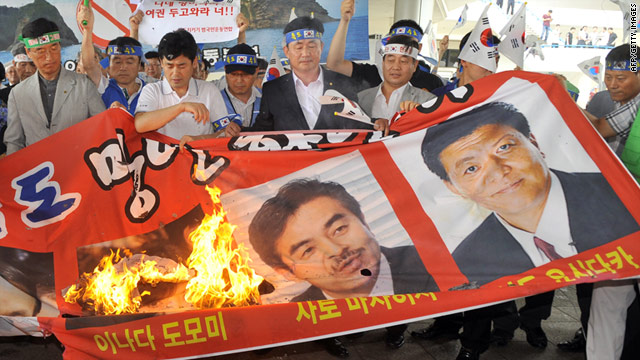
The photo to the left shows Korean protesters throwing salt and red pepper powder up into the air near the arrival gate inside the Korean airport while airport security stand by and watch.

Why would Koreans not want Japanese lawmakers visiting the Dokdo Museum on Ulleungdo since it supposedly has evidence to prove Korea's claim to Takeshima (Dokdo)?

The answer is that the museum does not have evidence to prove Korea's claims. It is essentially a propaganda facility designed to brainwash Korean school children and ignorant Korean tourists. The Korean government most probably did not want Japanese lawmakers seeing the distorted history and exhibits in the museum, fearing that they would return to Japan and expose the distortions and fabrications.

HERE is just one example of how the museum uses distorted models to try to support its false historical claim to Takeshima (Dokdo).

The Japanese lawmakers were denied entry to Korea because it was feared they would expose the lies of the Dokdo Museum.

Japan Probe has a great article on the story HERE.

The following is a Japanese language report of statements made by the Japanese lawmakers at the airport: