竹島問題の歴史

1.9.12

1840 Map - "Karte vom Japanischen Reiche," by Dr. Siebold

The 1840 map of Japan to the left was made by German physician and traveler Philipp Franz Balthasar von Siebold.  During his travels Dr. Siebold spent six years (1823 - 1829) in Japan, where he acquired some detailed maps of Japan and Korea made by the Japanese surveyor and cartographer Ino Tadataka. Siebold combined his knowledge of both Western and Japanese maps to make the map to the left, which is entitled "Karte vom Japanischen Reiche, nach Original-karten und astronomischen Beobachtungen der Japaner : die Inseln Kiu Siu, Sikok und Nippon."

One big problem with the Siebold map is that it included the non-existent island of Argonaut, which was a mismapping of the Korean island of Ulleungdo by the captain of the British ship "HMS Argonaut" in 1789. British Captain James Colnett mismapped Ulleungdo at the coordinates 37º 32' N and 129º 50' E, resulting in the non-existent island of "Argonaut" showing up on many Western maps about 110 kilometers to the northwest of the real Ulleungdo, which at the time was referred to by many Western nations as "Dagelet Island."

Dr. Siebold then labeled the non-existent Argonaut as "Takeshima," which was the Japanese name for Ulleungdo, and the real Ulleungdo as "Matsushima," which was the Japanese name for Liancourt Rocks. Dr. Siebold seems to have mistakenly shifted the names he saw on Japanese maps up from Ulleungdo and Liancourt Rocks to Argonaut and Ulleungdo, respectively.

Dr. Siebold's mistake caused a lot of confusion for some Japanese, who started to assume the non-existent island of Argonaut was Korea's Ulleungdo and the real Ulleungdo was Japan's Matsushima (Liancourt Rocks). The confusion came to a head in 1876 when Japanese businessman Mutoh Heigaku (武藤平学) petitioned the Japanese government
HERE to develop Matsushima, which he believed to be Japanese territory.

As part of discussions in the Japanese Ministry of Foreign Affairs to determine the location of Mutoh's Matsushima, Bureau of Documents Director Watanabe Kouki (渡辺洪基) provided two opinions,
HERE and HERE, on the possible location of the island.

Below is a close-up of the portion of the map that shows Ulleungdo (Matsushima) and the non-existent island of Argonaut (Takeshima).


31.8.12

1852 Weimar Geo Inst. Map - "Das Chinesische Reich"

The following map was published by the Weimar Geographisches Institut in 1852. Among the countries the map shows are Korea and Japan. In the Sea of Japan, the map also shows "I. Dagelet" and "I. Argonaut," which were "Ulleungdo" (Dagelet) and a non-existent, mismapped Ulleungdo (Argonaut).


29.8.12

Great Photo of Bak Seok-chang's (朴錫昌) 1711 Map of Ulleungo

Below is a great photo of the map Ulleungdo Inspector Bak Seok-chang (朴錫昌) made of Ulleungdo during his inspection of the island in 1711. The map is from Mr. Tanaka Kunitaka's Web site HERE. The bottom of the map represents the east shore of Ulleungdo. The small island just off the east shore is labeled "the so-called Usando" (所謂 于山島). On the same island is also written "groves of haejang bamboo" (海長竹田).

Two kilometers off the east shore of modern-day Ulleungdo is a small island named Jukdo, which has groves of haejang bamboo on it.

Also, notice the three prominent peaks in the center of the map. Because of those three peaks, Ulleungdo was sometimes called "Sambongdo" (峯島), which means "Island of Three Peaks."

Koreans claims that Usando was the old Korean name for Liancourt Rocks (Takeshima / Dokdo), but this 1711 Korean map is clear evidence that Usando was the old name for Ulleungdo's neighboring island of Jukdo. Liancourt Rocks are just barren rocks with no soil to grow haejang bamboo.


Great Photo of "Inner Ulleungdo Map" (鬱陵島內圖)

Mr. Tanaka has posted the great photo of Lee Gyu-won's 1882 "Inner Ulleungdo Map" (鬱陵島內圖) below on his Web site HERE. The map is only of the interior of the island. It does not shore the shoreline or any surrounding islands. The protrusions on the outer edge of the map represent mountain peaks.

Also, Mr. has written that he will post the "Outer Ulleungdo Map" (鬱陵島外圖), which is the mate to the map below, on September 22. The "Outer Ulleungdo Map" shows the shoreline and surrounding islands and rocky islets. I cannot wait to see a good, detailed photo of that map.


26.8.12

This is a clever video.


Yomiuri Simbun Editorial - "Govt must stress sovereignty over isles to intl community"

In an August 26 editorial entitled, "Govt must stress sovereignty over the isles to intl community," the Yomiuri Shimbun wrote the following:
It is vital for Japan to make the legitimacy of its territorial claim and the reasoning behind it widely known to the international community by taking the dispute to the international court. The government also needs to make efforts to help as many people as possible properly understand the Takeshima issue by explaining it thoroughly.
When Shimane Prefecture established "Takeshima Day" in 2005 to commemorate the 100th anniversary of the incorporation of Takeshima into the Prefecture, the Japanese public did not seem all that interested in the Takeshima dispute. Now, however, there seems to be much more Japanese interest.

I think there are two main reasons for the increased interest. One is that the Japanese public have learned much more about the history of Takeshima, which many now believe proves undeniably Japan's claim to the islets. The other may be that the Japanese have lost patience with all the Takeshima-related, anti-Japanese antics in South Korea. In other words, they have gotten tired of all the Korean stunts meant to say, "Hey, Japan, we've got your island. Nayh, nayh, nayh, nayh, nayh!"

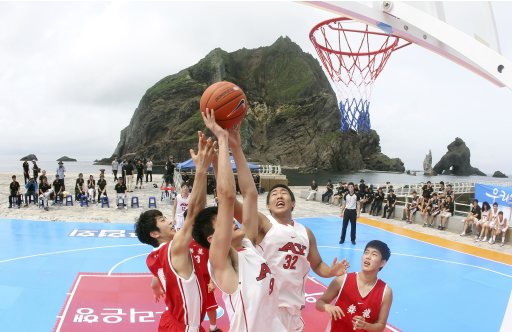
In the August 25 Yonhap/Reuters photo below, South Korean high school students play basketball on Takeshima (Liancourt Rocks / Dokdo), where they were shipped to once again say to Japan, "Nayh, nayh, nayh, nayh, nayh!"


24.8.12

"Seoul to remove 'illegal' base of monument erected on Takeshima islet"

The Japanese newspaper Asahi Shimbu reports HERE that the South Korean government has said that the circular base for the "Dokdo" monument to the left, which was erected on Liancourt Rocks by Koreans, was constructed illegally and must be removed.

The monument, which was unveiled on August 19, was erected by North Gyeongsang Province without obtaining permission from the central government in Seoul. However, on the back of the monument is engraved with "President Lee Myung-bak, Summer of 2012" in the Korean President's own handwriting. The Korean name from the island is written in Korean on the front of the monument. The Korean central government has said that the part of the monument with the inscription can stay, but the circular base must go.

The Japanese newspaper describes the dispute over the islets as follows:
Known as Dokdo in South Korea, the islands have been occupied by South Korea since the early 1950s despite a lack of legal authorization from either Japan or the United Nations.
I would just add that the United States rejected the Korean government's claim to the islets in an August 10, 1951 letter from US Secretary of State Dean Rusk to the Korean Ambassador, in which the US Secretatry wrote the follow:
As regards the island of Dokdo, otherwise known as Takeshima or Liancourt Rocks, this normally uninhabited rock formation was according to our information never treated as part of Korea and, since about 1905, has been under the jurisdiciton of the Oki Islands Branch of Shimane Prefecture of Japan. The island does not appear ever before to have been claimed by Korea...."

"Korea to Send Back Noda's Letter Claiming It Violated Protocol

The Korean newspaper Chosun Ilbo reported HERE that Korea would return the undelivered letter Japanese Prime Minister Yoshihiko Noda wrote to Korean President Lee Myung-bak protesting his visit to Liancourt Rocks. The reason given for returning the letter was that it violated diplomatic protocol since its contents had been announced in advance. Korea also claimed the letter was inaccurate since it referred to the Rocks by the Japanese name instead of the Korean.

According to an article in the the Japanese newspaper Asahi Shimbun HERE, Korean embassy officials trying to return the letter were turned away at the gate of the Japanese Foreign Ministry because they had not made an official appointment.

UPDATE: Jiji Press - "Japan Refuses to Accept Takeshima Letter Returned by Seoul"
Seoul, Aug. 23 (Jiji Press)--Japan's Foreign Ministry refused to accept a letter Thursday that was sent by Prime Minister Yoshihiko Noda to South Korean President Lee Myung Bak but returned. 
   An official at the South Korean embassy in Tokyo visited the ministry to return the letter, but the ministry refused to meet the official. 
   Following this, the South Korean embassy sent the letter back by registered mail.
Due to the unusual diplomatic spat, the bilateral relationship looks certain to deteriorate further. 
In the letter, sent Friday, Noda criticized Lee's unprecedented visit to the Sea of Japan islands of Takeshima, controlled by South Korea, on Aug. 10 and expressed regret over Lee's remarks on seeking an apology from Emperor Akihito for Japan's past colonial rule.
UPDATE 2: Dialy Yomiuri Online gives more detail HERE on the Korean President's refusing to receive the Japanese Prime Minister's letter, including the following quotes:
  • According to the Yonhap news agency, a senior official of the South Korean presidential office said, "It makes no sense to reply to comments that are not true."
  • The news agency quoted a South Korean government source as saying: "Even if our response [to Japan] is seen as diplomatically rude, there is no reason to change our principles on this matter. If we see this issue from the other side, Japan also has gone against diplomatic protocol in sending [Noda's] personal letter."
  • Chief Cabinet Secretary Osamu Fujimura expressed concern over the issue. "Regarding diplomatic protocol, I can't think of a letter sent from a national leader to another leader being returned," he said at a press conference Thursday morning.
  • A senior Foreign Ministry official said, "The fact that South Korea has decided to take an unusual step in response [to Noda's letter] may prove that the nation is shocked by Japan's objections [to Lee's remarks and actions]."

23.8.12

Korean Diplomat Suggests Japan Bet Its Claim to Tsushima Against Korea's Claim to Dokdo at ICJ

Korea Times article HERE says that Korean diplomat Chang Dong-hee has suggested that Japan bet its claim to Tsushima against Korea's claim to Dokdo. Specifically, Mr. Chang said the following on a Korean radio program:
"If Japan lodges a protest with Korea over Dokdo, it should bet Tsushima."
Personally, I think it is a great idea. Japan agrees to take its claim to Tsushima to the International Court of Justice (ICJ), and Korea agrees to take its claim to Dokdo, and both countries agree to abide by the Court's rulings. In other words, Japan bets its 1,500-plus-year claim to Tsushima and 400-plus-year claim to Liancourt Rocks (Takeshima / Dokdo) against Korea's claims to the two islands.

I would like to nominate that Korean diplomat for a Noble Peace Prize.

22.8.12

1954 - "Report of the Van Fleet Mission to the Far East"

Between April 26 and August 7, 1954, retired 4-star General James Alward Van Fleet traveled to Asia as a Special Ambassador for US President Dwight D. Eisenhower to chronicle a survey of the United States Military Assistance Programs in the Far East. He and his team conducted surveys of the military, economic, and political situation in the region. The report was submitted to the US President on October 4, 1954.

General Van Fleet had fought in World I, World II, and the Korean War. In 1951 he replaced General Matthew B. Ridgway as commander of the US Eight Army and United Nations Forces in Korea. His only son, Captain James A. Van Fleet, Jr. was a B-26 bomber pilot during the Korean War, where he was killed. When he retired from active duty in 1953, his medals and awards included three Distinguished Service Crosses, three Distinguished Service Medals, three Silver Stars, four Bronze Stars, and three Purple Hearts for wounds received in combat. President Harry S. Truman described him as "the greatest general we have ever had...." He died on September 23, 1992 at the age of 100.

In his "Top Secret" 1954 report, Special Ambassador Van Fleet included a topic entitled "Ownership of Dokto Island," where he comfirmed that the United States and the "Treaty of Peace with Japan" recognized "Dokdo" as Japanese territory. He wrote that South Korea had been confidentially informed of the US position, but that the US position had not been made public.

Below is the relevant paragraph from the original document, and below that is the transcribed section of the report from which it came. LINK

Inventory of Commitments & Problems-Korea

III. Korean Problems With Other Asian Nations

A. Japan

The United States is vitally interested in the establishment of close and friendly relations between Japan and the Republic of Korea. The security of the two countries against the Communist threat from the Mainland of Asia is inextricably intertwined, and failure to achieve a rapprochement between them creates grave weaknesses from a security point of view that the Communists have sought and will continue to seek to exploit. For these reasons, the United States must endeavor in every way feasible to bring about a rapprochement between the two countries and mutually satisfactory settlement of the major problems outstanding between them.

The failure to achieve settlement thus far stems basically from the lingering hostility between the two peoples resulting from Japan's long rule over Korea. The bitter experiences of the Koreans under the Japanese rule understandably left a deep hatred and distrust of Japan in the minds of Koreans. These strong emotions representing the past seem to be more real in their minds that the present. They fear a renewal of Japanese aggression and view every Japanese move with suspicion. They are alarmed at Japan's reviving strength.

It is believed that the Japanese would like to forget the past--which holds unpleasant memories for them as well as the Koreans. They do not believe that their 40-year occupation of Korea was an entirely unmixed evil. Japan believes that if it was indebted to Korea, the debt was more than taken care of by the transfer to the Republic of Korea Government of Japan's entire public and private holdings in Korea at the end of World War II. Basically, both countries wish to establish normal diplomatic and commercial relations; they wish to trade with each other despite certain official utterances to the contrary.

There are several specific issues between the two countries that deserve careful analysis. It is believed that all of these can be resolved if serious and patient efforts are made and the United States Government provides the leadership in suggesting a strong person as a mediator who has the respect of both the Korean Government and the Japanese Government. These issues are set forth below:

1. Fisheries

Of the several problems at issue between Japan and Korea, the fisheries problem is by far the most important, not only because it is of vital concern to the Japanese (a nation that lives on fish) but because the Republic of Korea Government has taken overt action against Japanese fishermen apprehended fishing in the Sea of Japan (or Eastern Sea, as the Koreans call it) approximately 60 miles from Korean shores. The Japanese have eagerly sought a settlement with the Republic of Korea. As for the Koreans, they are genuinely concerned over the possible depletion of their fisheries resources by the superior Japanese fishing fleet. This is particularly acute for the Koreans because they do not have adequate vessels and equipment and trained personnel to fish in waters that are not closely adjacent of Korea. This problem involves the enforcement of the so-called "Rhee Line" or "Peace Line" in the Eastern Sea.

The essential facts are that the Republic of Korea Government has unilaterally proclaimed its sovereignty over a large area of the high seas bordering Korea and by the use of the Republic of Korea Navy has attempted to exclude Japanese fishermen from operations within the area. At times, the Republic of Korea Navy has fired upon Japanese vessels; some of the vessels have been apprehended and taken to Korean ports. After the crews have been tried and sentenced, most of the captured fishermen have been released, but the vessels usually have been detained and are now being reportedly operated by the Republic of Korea. It is believed that the Japanese Government is willing to enter into a reasonable fisheries conservation agreement that would guarantee the preservation of the fisheries and restrict Japanese operation in the area.

According to President Rhee, the "Peace Line" serves a three-fold purpose:
a. Conservation of valuable marine resources in Korea's coastal waters;
b. Elimination of future friction between Korea and Japan with respect to fisheries resources; and
c. Sea defence against Communist infiltration.
The position of the Republic of Korea Government has been to insist on the recognition of the so-called "Peace Line." The United States Government has consistently taken the position that the unilateral proclamation of sovereignty over the seas is illegal and that the fisheries dispute between Japan and Korea should be settled on the basis of a fisheries conservation agreement that would protect the interests of both countries. The chronology and other aspects of the fisheries is discussed in more detail in Enclosure No. 1.

2. Korean Residents in Japan

The Republic of Korea contends that the Koreans, resident in Japan on August 9, 1945, who now reside there, should be given treatment more favorably than that given to the average foreign national in Japan. There are now approximately 600,000 Koreans in Japan. A substantial number of these Koreans were conscripted laborers who were forcibly taken during World War II for Japanese production purposes. They were compelled to work in the mines and military factories. A tentative argument on the nationality status and treatment of the Koreans residents in Japan was reached at the second Japanese Conference of February-April 1952. It was agreed that all should be regarded as citizens of the Republic of Korea, and that, except for illegal entrants, they would be entitled to special treatment to enjoy many privileges ordinarily reserved for Japanese citizens. The agreement , however, has not come into effect because the Conference broke down over other issues. It is understood that the Republic of Korea refuses to approve this agreement until all outstanding issues were settled.

It would seem that the settlement of the problem of the Korean residents in Japan should not prove unduly difficult, if and when general settlement of other outstanding issues is reached. If relations between Japan and Korea continue to deteriorate, however, the Korean minority problem will become increasingly acute. It is understood that a high percentage of the Koreans in Japan, excluded from normal occupations, are on Japanese relief rolls or engaged in illegal activity and many of them are active Communists. These facts do not endear the Korean residents to the Japanese; retaliatory measures against the Korean minority by the Japanese Government--or by the Japanese people themselves-- remain distinct possibilities. The Republic of Korea advised this Mission that the Koreans "now live in a sort of 'no man's land', neither Japanese nor Korean, deprived both of the protection afforded to Japanese nationals under Japanese laws, ad of status of foreign nationals as provided in international law. Depending upon circumstances, they were sometimes treated as Japanese and, at other times, as foreign 'stateless' persons. They had no recourse to law or means of remedy against many discriminations which operated against them. * * * "

3. Korean-Japanese Trade Relations

The current trade relations between the Republic of Korea and Japan are not satisfactory; recent developments show little prospect of early improvement. Apparently, discrimination against Japan by the Republic of Korea continues, on a de fact basis, despite which equal treatment was provided for Japanese bidders. Only after pressure on the Republic of Korea Government by actual withdrawal by certain Foreign Operations Administration authorizations were these revisions made in the Korean Import Procurement Regulations.

Notwithstanding this revision in the Korean Import Procurement Regulations, the Japanese Government has recently informed the United States Ambassador in Tokyo that various devices and pressure are being used to prevent the placing of orders in Japan for goods to be used in Korea. These include the following--Korean firms state they have been told that if they purchase in Japan, they would be denied credit facilities at the Bank of Korea and would be black-listed by the Korean Procurement Agency for any future business regardless of the source of supply.

It seems clear that the Korean Government does not intend to comply with the new Import Procurement Regulations since the embargo against Japan is apparently retained in full effect. This action on the past of the Korean Government obviously prevents Korea from receiving the benefits of lower priced Japanese goods with this added advantage of early delivery; increases the cost of the Korean Procurement Program, thereby reducing its possible scope; it prevents United States dollars doing double duty by assisting in the support of Japanese economy (urgently needed because of the decline in special dollar receipts arising from offshore procurement and expenditures by security forces) as well as in rehabilitating Korea.

The trade balance between Japan and Korea over the past few months has not been favorable; the outstanding balance that Korea owes Japan amounts to approximately $37,000,000. The United States Ambassador in Tokyo states that the Koreans have cited this unfavorable balance of trade as evidence of Japanese embargo against Korean exports to Japan. Japan recently developed an import program for Korean products that include rice, laver (seaweed), and certain other products that are estimated at approximately $21 million annually.

Moreover, Japan has indicated a willingness to purchase substantial quantities of Korean rice provided the price is not greatly in excess of prices in other supplying countries. To date, the amount of rice exported to Japan, the natural export market for Korean rice, has not approached that exported in prior years. Early in September 1953, the Republic of Korea, on the basis of the bumper rice crop, planned to export 150,000 to 200,000 metric tons of rice to Japan. The Republic of Korea believed that these rice exports to Japan would provide the necessary foreign exchange to import an equivalent tonnage of cheaper grains together with a net gain of $20 million of foreign exchange. The Republic of Korea did not begin to purchase rice for export until December 10, 1953, and it was slow in making money available for rice purchases. Only about 120,000 tons of rice, therefore, became available for export.

The unresolved problem relates to the price at which the Republic of Korea will receive for the rice exported to Japan. It is reported that Japan can buy rice from Formosa and other Southeast Asian countries at $195 to $210 per ton delivered. and United States rice from California at $205 per ton delivered. The Republic of Korea, however, on the basis of the official rate of exchange of 180 Hwan to $1 calculates that it has made an investment of $290 per ton in the rice purchased for export. For this reason, and possibly for bargaining purposes, the Republic of Korea officials have asked $290 per ton. It is reported that Japan has offered $225 per ton for Korean rice if the proceeds are applied to the current indebtedness of the Republic of Korea to Japan under the Republic of Korea-Japan Trade Agreement, or $200 per ton if the proceeds are in free exchange. The Korean rice has always commanded premium price because it is considered the best rice by the Japanese.

The exportation of rice to Japan has become entangled with other economic and political questions including the factors involved in the breakup of the Republic of Korea-Japan talks in late 1953 precipitated by certain ill-advised statements about Korea by the Japanese delegate, Kubota (see page 25); the dispute between the Republic of Korea over each other's performance under the trade agreement; and the embargo by the Republic of Korea on trade with Japan. The official position of the Republic of Korea is that its embargo policy is justified because of Japan's trade restrictions against Korea. Figures are cited showing that Korean exports to Japan amounted to $8 million during the 12-month period ending March 31, 1954, that is, only one-half the amount mentioned in the target in the trade agreement; whereas, imports from Japan (including Foreign Operation Administration financed imports) total almost $65 million, or more than double the target mentioned in the trade agreement. The deficit in Korean exports to Japan was in commodities other than rice because rice was not a specified commodity in the trade agreement. The Japanese are also charged with imposing deliberate restrictions on imports from the Republic of Korea and with over-pricing and poor quality of Japanese exports to the Republic of Korea. On the other hand, Japan complains that the indebtedness of the Republic of Korea under the trade agreement has risen far above the swing limit provided for in the agreement, and that payments are long overdue.

The problem incidental to exporting rice to Japan can be readily solve once the basic issue of Republic of Korea-Japanese relationships is solved. It is important, however, that Republic of Korea export substantial quantities of rice to Japan or to some other country. The Foreign Operations Administration Agricultural Mission in 1953 and the Nathan Associates in 1954 regarded rice as the most important of Korea's potential exports and one that must eventually be increased to about 500,000 tons per year. It is, therefore, important for the Republic of Korea to export rice and Japan is its natural market. Immediate exportation of the present stocks is desirable if deterioration or damage by insects is to be prevented.

4. Ownership of Dokto Island

The Island of Dokto (otherwise called Liancourt and Take Shima) is in the Sea of Japan approximately midway between Korea and Honshu (131.80E, 36.20N). This Island is, in fact, only a group of barren, uninhabited rocks. When the Treaty of Peace with Japan was being drafted, the Republic of Korea asserted its claims to Dokto but the United States concluded that they remained under Japanese sovereignty and the Island was not included among the Islands that Japan released from its ownership under the Peace Treaty. The Republic of Korea has been confidentially informed of the United States position regarding the islands but our position has not been made public. Though the United States considers that the islands are Japanese territory, we have declined to interfere in the dispute. Our position has been that the dispute might properly be referred to the International Court of Justice and this suggestion has been informally conveyed to the Republic of Korea.

The Mission was advised by Republic of Korea that:
"What is still worse is that Japan now claims the possession of the little islet of Dokto known Liancourt Rocks near the Woolnungdo known as Dagelet. Japanese officials are making frequent visits to the islet with armed vessels molesting Korean fishermen there. They set up posts here and there in the islet with description declaring as if it were Japanese territory. Throughout our history and knowledge up to the very moment of the declaration of sovereignty over adjacent seas (Rhee Line), Korea's sovereignty over it has never been contended by any country, as it has long been an immovably established fact that the islet, Dokto, has been historically as well as legally a part of Woolnungdo (Dagelet) Korean territory."

19.8.12

1960 Apr 27 - American Ambassador says Takeshima is Japanese territory, not Korean

On 27th April, 1960, American Ambassador Douglas MacArthur II sent telegram to J. Graham Parsons, Assistant Secretary of State for East Asian and Pacific Affairs, in Washington, and in it, he says that “Therefore we should also press new ROK regime to return Takeshima to Japan.” We already knew that U.S. warned ROK that Takeshima is Japanese island in both 1951 and 1952.

Telegram from D.MacArthur to SECSTATE in1960_1For Ass’t Sec’y Parsons from MacArthur
Seoul for Ambassador McConaughy

Now that we have prospect of new and democratic regime in Korea I strongly recommend that as soon as possible we seize opportunity to try to bring about durable solution to ROK-Japan dispute. As long as Rhee held power there seemed little chance of any solution but now we have entirely new situation which could lead to liquidation of ROK-Japan controversy. Implications of ROK-Japan dispute are not just bilateral between GOJ and ROK but deeply and directly involve US and our inescapable solution is to be found it will be produced only by our good offices and working closely with both ROK and GOJ. It is of utmost importance that we identify and be prepared to move swiftly for solution those specific ROK-GOJ problems which prevented progress toward basic settlement this festering dispute. We do not know what response Communists may make to new ROK regime and it is vital we try to put ROK-GOJ house in order as soon as possible.
 
Telegram from D.MacArthur to SECSTATE in1960_2While Rhee regime violated most basic tenets of democracy in authoritarian police rule imposed on Korean people, it has also in past done violence to most fundamental principles of international conduct and morality by committing acts of piracy on high seas around Rhee Line and then imprisoning and holding as political hostages Japanese fishermen and by seizing and holding non-Korean territory by force. The uncivilized practice of hostage diplomacy is one of our serious charges against Communist China and if continued by ROK it will be a great liability to a new democratic ROK regime.


I therefore recommend strongly that as soon as new regime is in control in Korea (whether or noti it be of interim character) we use all our influence to persuade it (1) to release and return to Japan all repeat all Japanese fishermen hostages (including those who have not completed their sentences) who have suffered so cruelly from Rhee’s uncivilized and oppressive acts and (2) to cease practice of seizing Japanese fishing vessels on high seas. This would not only rid new ROK reegime of liability of practicing hostage diplomacy but also more than anything else would lay foundation in Japan for really fruitful negotiations. At same time I would be prepared to press Kishi and GOJ most strongly that in return for repatriation of all fishermen, Japanese would exercise self-restraint in their fishing operations in Korean Straits until reasonable opportunity had been given for negotiation of mutually agreed ROK-Japan fishing conservation agreement.

Telegram from D.MacArthur to SECSTATE in1960_3In addition to seizing Japanese boats on high seas and practicing hostage diplomacy, Rhee regime also seized by force and is holding illegally Takeshima Island which has always been considered as Japanese territory. This is very serious and permanent irritant in Japan-ROK relations and there can be no over-all ROK-Japan settlement until this Japanese island is returned to Japan. Therefore we should also press new ROK regime to return Takeshima to Japan. If it is unwilling to do so pending satisfactory conclusion of over-all ROK-Japan negotiations, new regime should at least signify a willingness to withdraw from Takeshima as part of mutually satisfactory settlement of other outstanding issues between two countries. While we should press strongly for return of Takeshima to Japan, if by any chance new regime were unwilling to do so we should, as very minimum, insist that they agree to submit matter to International Court of Justice for arbitration.

Telegram from D.MacArthur to SECSTATE in1960_4Finally, we should inform new regime very clearly that it must be prepared to adjust its relations with Japan on terms of reciprocity, in such matters as diplomatic missions, visits by businessmen and journalists, commercial trade. Japanese have suffered Rhee’s occupation-minded approach for eight years and will be unwilling to accept such indefensible treatment from his successor. In its own interests, new regime should start with conformity with normal international standards of conduct, and could most usefully begin (in terms of Japanese and other free world opinion) by permitting Japanese diplomatic mission to enter and function in ROK on same terms ROK Embassy operates here.

If we now move swiftly with new ROK regime which should generally be receptive to our views because of our helpfulness, we may have initial opportunity, which may never reoccur, to influence its position on Japan-ROK problem. Japanese would certainly welcome warmly and reciprocate fully, measures indicating new ROK regime willing take “new look” at Japan.

MacArthur

Douglas MacArthur II is a nephew of General MacArthur and an American diplomat. He served as U.S. ambassador to Japan from 1957-1961.

The original documents are from Nikaidou.com with his permission. Thanks opp, for important information.

More to read...:

1951 - Jul 9 - Coversation of Yu Chan Yang with John F. Dulles
1951 - Jul 19 - The 2nd Conversation between Yu Chan Yang and John F. Dulles
1951 - Aug 2 - Another letter from You Chan Yang
1951 - Aug 3 - Bogg’s Memorandum
1951 - August 9 -Dean Rusk Letter (A letter by US Secretary of State Dean Rusk to the Korean Ambassador )
1951 - Sep 9 - San Francisco Peace Treaty
1951 - Sep 21 - Korean Government comprehended Takeshima/Dokdo was affirmed as a Japanese Territory in Peace Treaty
1952- Jan 18 - Syngman Rhee Line
1952 - Nov. 5 - Confidential Security Information of USA
1952 - Dec. 4 - Confidential Security Information of USA
1952 - Dec 4 - “American Embassy’s Note Verbale No.187” - U.S. iterates Rusk Note to ROK.
1953 Jul 22 - Confidential Security Information of USA “Possible Methods of Resolving Liancourt Rocks Dispute between Japan and ROK”( The United States Government's understanding of the territorial status of this island was stated in assistant Secretary dated August 10,1951.")
1953 - Jul 22 - US Doc. Reconfirms Dean Rusk Letter (Letter from Office of Northeast Asian Affairs To E. Allan Lightner American Embassy, Pusan Korea by L. Burmaster Office of U.S. Northeast Asian Affair )
1953 - Nov 30 - Secret Security Information of USA
1953 - Dec. 9 - SECRET SECURITY INFORMATION by Dulles

17.8.12

Asahi Shimbun - "Takeshima issue explained in Q&A format"

Below is an August 16, 2012 article from the Japanese newspaper Asahi Shimbun. LINK

It is a pretty good article, but it oversimplifies the answer to the question, "What about the history?" It fails, for example, to mention that while Japan has numerous maps and documents to support her claim to Liancourt Rocks (Takeshima/Japan), Korea has none to support hers.

Also, how can Korea claim the Rocks were "taken by force" in 1905 when the Rocks had never been part of Korean territory or even had Koreans living on them? In fact, the only way Koreans could get to the Rocks at the time were as deckhands on Japanese fishing boats.
The Asahi Shimbun 
South Korean President Lee Myung-bak's surprise visit to the disputed Takeshima islets on Aug. 10 sent relations with Japan into a tailspin.  
Staff Writer Toru Higashioka attempts to put the issue in perspective in the following question-and-answer format:  
Question: What was the Japanese government's reaction to Lee's visit?
Answer: Both Prime Minister Yoshihiko Noda and Foreign Minister Koichiro Genba lodged strong protests.  
Q: What is the Japan's position with regard to the islets, which are called Dokdo in Korean?  
A: While South Korea claims the islets, Tokyo maintains they are Japan's sovereign territory, both historically and under international law. It also maintains that South Korea is illegally occupying them.  
Q: What is at issue right now?  
A: Lee's visit to Takeshima was an affront to Japan. Here was the leader of a country landing on territory it illegally occupies. His visit was completely unacceptable for the Japanese government.  
Q: Why does Japan maintain that South Korea is illegally occupying the islets?  
A: The 1951 San Francisco Peace Treaty stipulates all territory that Japan should renounce all rights, titles and claims to. But it does not include Takeshima. Then in January 1952, South Korean President Rhee Syngman one-sidedly declared the Rhee Syngman Line, or boundary, on the open sea, putting Takeshima on the South Korean side. South Korea went ahead and stationed security forces on the islets, effectively placing them under its control.  
Q: What about history?  
A: Japan claims it established sovereignty of the islets early in the Edo Period (1603-1867). Takeshima was incorporated into Shimane Prefecture based on a Cabinet decision in 1905. That same year, Japan declared that Korea no longer has diplomatic sovereignty as it moved to annex the Korean Peninsula in 1910. This is why South Koreans regard the islets as having been "taken by force." As a result, the issue has stirred up patriotism and anti-Japan sentiment among South Koreans.  
Q: How has Japan coped with the problem?  
A: In 1954 and 1962, Japan proposed to South Korea that the dispute over sovereignty be referred to the International Court of Justice. But South Korea rejected the idea. So far, Japan has refrained from taking the matter to the court out of consideration for its peaceful relationship with South Korea. Past attempts by Japan to resolve the issue in the ICJ were met with strong opposition from Seoul.  
Q: In spite of all this, Lee went ahead with the visit, didn't he?  
A: Genba said Japan no longer needs to give South Korea's stance on the issue any consideration and can go ahead with filing a suit with the ICJ.  
THE ASAHI SHIMBUN

14.8.12

Japanese Unhappy with South Korean President's Visit to Liancourt Rocks (Takeshima/Dokdo)

"Hey, look at us! We got your island. Nayh, nayh, nayh, nayh, nayh!"

2006 Email Informing Me My Teaching Contract Would Not Be Renewed Because of Dokdo Postings

The screenshot to the left is of a December 22, 2006 Email I received from the English Department Head at Gachon University in Incheon, South Korea, where I worked as an English instructor for six years. The email informed me that my employment contract with the school would not be renewed for the 2007 school year. The Department Head believed it was because of my Dokdo postings on the Internet. She wrote: "I think there is little doubt that the school made this decision because of the Dokdo problem."

I am posting it because Robert Koehler of The Marmot's Hole has questioned HERE whether the refusal to renew my employment contract was really due to my Dokdo postings. Here is my translation of the Email I received from my department head at Gachon University:
Teacher Gerry, 
Yesterday, I called again to the Dean of Academic Affairs and urged him to quickly make a decision on your contract problem. This morning, at a meeting attended by the president and the deans of the school, your contract problem was discussed, and it was decided that your contract would not be renewed. I was informed by the Dean of Academic Affairs at about 11 a.m. At the time I was on a train to Daejeon to attend an academic meeting, so I could not contact you right away. I am contacting you now after having arrived home just a little while ago. I think there is little doubt that the school made this decision because of the Dokdo problem. It also hurts me to have to relay this news.
The English Department at the school had two Korean professors and two foreign instructors, including me. In addition to getting the above Email from the Korean professor who was the department head, I also secretly recorded the other Korean professor telling me in both Korean and English that she was in the room arguing that my contract be renewed when the Dean of Planning told her "The Dokdo problem is just too big" to renew my contract. The Dean of Planning had told me just a month or two earlier that I did not have to worry about not being rehired.

Soon after I posted the news on the Internet, I got a call from a Korea Times reporter asking to interview me. I agreed and met her at the McDonalds at the Sinchon Rotary subway entrance. She asked me to bring the secret recording and the copy of the Email I received. The article she wrote about the interview can be read HERE.

Judge for yourselves.

12.8.12

Korean Soccer Player Denied Medal After Displaying "Dokdo" Sign

According to a New York Times article entitled "South Korean Denied Medal After Political Statement," South Korean soccer player Park Jong-soo was barred from receiving his bronze medal at the London Olympics on Saturday for displaying a Korean sign that read "Dokdo Is Our Land" (독도는 우리 땅). Mr. Park was not on the podium with his teammates at the medal ceremony.

Mr. Park held up the sign after South Korea's 2-0 victory over the Japanese soccer team.

The article said that Mr. Park faces investigations by both the International Olympic Committee and FIFA, soccer's governing body, because both organizations strictly enforce rules forbidding athletes from making political statements on the field.

Link to Yahoo! News, Canada Article

9.7.12

Man Rams 1-ton Truck into Gate of Japanese Embassy in Seoul

At 4:55 a.m. on July 9th, a 62-year-old man from Seongnam City, South Korea drove a 1-ton truck into the front gate of the Japanese Embassy in Seoul, South Korea. Attached to the truck was a sign that read, "Dokdo Is Our Land." The man has been arrested.

(Photo from Joong-ang Ilbo Article HERE)

According to Seoul police, there were no injuries, but the front gate of the embassy has been pushed in about one meter.

The man told police that he was protesting a recent incident in which a Japanese man videotaped himself standing next to a "Comfort Women" memorial in front of the embassy with a stick that read, "Takeshima is Japanese Territory." Takeshima is the Japanese name for Dokdo, a small group of rocky islets that is the subject of a territorial dispute between Japan and South Korea. South Korea has illegally occupied the islets since the 1950s.

According to THIS Wall Street Journal blog article, police said the man had a hand-written note in his pocket that read as follows:
“... driving a stake at the comfort woman’s statue is doomed to God’s wrath. If I die please cremate me and scatter my ashes in the waters near Dokdo.”
The name "Comfort Women" was a euphemism that was once used by both Koreans and Japanese to refer to prostitutes, especially prostitutes for the military. Japan provided comfort women for its troops during World War II, and South Korea provided them for Korean and UN troops during the Korean War and beyond. The Korean newspaper Dong-a Ilbo reported in an October 1959 article HERE that there were 261,089 "comfort women" working in Korea in 1959 and that 66% of them were infected with a venereal disease.

KOREAN LINK

JAPANESE LINK

2.7.12

White House Rejects Petition for "Sea of Japan" Name Change

The United States has rejected a petition asking that the name "Sea of Japan" be changed to the "East Sea." Go HERE to read the petition and the response. There is also a Korean and Japanese translation.

14.5.12

Korean students only scream and yell "Dokdo is our land," but cannot explain why.

This Korean instructor is complaining that the Japanese are winning the international opinion war for their claim to "Dokdo" (Liancourt Rocks - Takeshima) because they can logically explain the reasons for their claim and are doing so in several different languages. He says that Korean students, on the other hand, only scream and yell "Dokdo is our land," but are unable to explain why. The instructor predicts the world will consider "Dokdo" to be Japanese territory within thirty years time.

10.5.12

What happens in Korea if you disagree with its Dokdo claim?

Today I clicked on a link that took me to the Dokdo Research Institute Web site where I decided to check out their Open Discussion Board. There I found a post HERE dated January 4, 2012. Here is the translation of that post:
The Usando shown on an old document is Jukdo?? 
http://blog.naver.com/royalty1234  
The Bulletin Board of this person's blog says that Dokdo is Japanese territory. If you go in and look at it, he claims that the Usando shown on an old document is Jukdo. He shows various materials to support his claim. The material he uses is wrong, and his claim is wrong. I urge to you refute them.
If you click on the link to the offending blog, you now get a message from the blog provider, Naver, that reads as follows:
This is a Closed Blog. Access to this blog has been restricted by request of the Korea Communications Standards Commission.
Old Korean documents show Usando (于山島 - 우산도) to be Ulleungdo's neighboring island of Jukdo (竹島 - 죽도), which is only about 2 kilometers off Ulleungdo's east shore. However, Koreans generally claim that "Usando" was the old name for "Dokdo" (Liancourt Rocks). Apparently, in Korea, one is not allowed to disagree with the general Korean claim.

The Lesson: "Don't use a Korea-based internet service provider to create a blog refuting Korea's claim to 'Dokdo' because opposing opinions are apparently not allowed."

The following are the screenshots of the bulletin board post on the Dokdo Research Institute Web site and of the message from Naver saying the blog is closed.


8.5.12

Japan Probe: "New Jersey Japanese School Wins Takeshima Lawsuit"

A lawsuit brought against a Japanese School in New Jersey for teaching that Takeshima (Dokdo) is Japanese territory has been dismissed. A Korean-American who did not like the school's using a Japanese Social Studies textbook that taught Takeshima (Dokdo) was Japanese territory filed a lawsuit against the school last year. You can read more about the lawsuit in English at "Japan Probe" HERE.

You can read the legal decision HERE.

Japanese readers can read about it in Sankei News:

「日本人学校が竹島で偏向教育」韓国系米国人の訴え棄却 米ニュージャージー州

A Korean translation can be read at the KJClub HERE by clicking on 韓国語で表示.

In the footnotes of her legal decision, the Judge wrote the following:
As a former civil mediator, it would certainly be tempting to suggest that this historic Asian-Pacific dispute, which apparently remains the cause of wide-ranging emotions and politics on both sides, be settled through a designation of one islet to each country. Clearly, if the solution were that simple, it would have occurred before today.

7.5.12

1869? Map of Korea - "東國八域山川一綂全圖." Shows Ulleungdo with a neighboring island labeled "Udo" (于島)

The following Korean map is entitled "Dongguk Pal Yeok San Cheon Il Tong Jeondo" (東國八域山川一綂全圖), which means "Complete Map of All Eight Regions of Mountains and Streams of the Eastern Country." The map is believed to have been made in 1869 and is houseed in the Library of Congress of the United States. LINK

One of the interesting things about the map is that it shows the island of Ulleungdo (鬱陵島 - 울릉도) with a neighboring island labeled "Udo" (于島 - 우도), which was one of the old names for Ulleungdo's neighboring island of Jukdo (竹島 - 죽도), a small island just two kilometers off Ulleungdo's east shore.


6.5.12

Later 1800s - "Takeshima Map Explanation" (竹島圖說) Kensaku Kanamori - "文鳳堂雑纂"

The following comes from a Japanese text entitled "A Compilation of Topics by Bun Ho Do, Vol. 16" (文鳳堂雑纂 - 十六), which seems to have been a volume compiled sometime before 1886 by  Kensaku Kanamori (金森謙建策).

One reason I am posting this text is that I think it was mentioned in an 1876 letter entitled "Concerning Matsushima 2," by Watanabe Kouki (渡辺洪基), who was Director of the Bureau of Documents in Japan's Ministry of Foreign Affairs at the time. Mr. Watanabe was trying to determine if the Japanese name Matsushima (松島) was being used to refer to the Korean island of Ulleungdo (鬱陵島) or to some other island. Another reason I am posting it is that it seems like a very interesting text.

Traditionally, the name "Matsushima" or "Oki's Matsushima" was used by the Japanese to refer to Liancourt Rocks, but Mr. Watanabe suspected that it was also being used to refer to Ulleungdo. In the text, Ulleungdo is referred to as "Takeshima" (竹島) and Liancourt Rocks as "Oki Domain's Matsushima" (隠岐国の松島).

The following is the referrence to the Kensaku (金森謙) text from Mr. Watanabe's 1886 letter:
又金森謙ノ書ニ竹島周圍大凡十五里トアリ 
Also, in the text by Kensaku (金森謙), the circumference of Takeshima was written as 15 ri.
(Mr. Tanaka's Web site is the source of this text HERE.)
Takeshima Map Explanation (竹島圖說)  
In the text “ A Record of the Land of Japan” (日本風土記), “TA (他) KE (計) JI (甚) MA (麽) refers to Takeshima (竹島).   
The family of Kitazono (北園子家), a retired retainer of this Domain, has a text of his entitled “Takeshima Map Explanation” (竹島圖說), in which this family’s ancestor, Mr. Tsuuan, (通葊氏) recorded old stories during the Hohreki Era (1751 – 1764) that were passed down among the people of Inshu (因州). So little is known about it/them that this book can, indeed, be called a treasure.  
I also recorded the story of an oarsman from Iwami (石見). His name was Chozo ((長蔵), from the village of Hamada (濱田). He still lives in Bittyu Province (備中), but is temporarily staying in the town of Obara/Kobara (小原街). (This town may have been what is now the neighborhood of Obara (小原町) in the village of Kasubuchi (粕淵村) in the Ohchi District of Iwami Province (石見囯.)  
These stories are passed down, but I have added to them. I hope this helps those interested in learning about the geography of Takeshima.  
Written by Kanamori Ken Kensaku (金森謙建策 題)  
As for the map of the island, I have made a copy and attached it.  
Someone told me that an essay by Itoh Tohgai (伊東涯) said that the Island of Jikuro (軸羅島) in the Book of Sui(隋書) must be this Takeshima. According to the essay, the circumference (of the island) was 40 ri. I believe his view is probably correct.  
竹島図説  
日本風土記 他計甚麼 竹島云々 
予藩之隠士北园子家、有一書在焉 名曰、竹嶋図説
此其家祖、通葊氏者、宝暦年間 甞所傳記 于因人某而
世間知之殆鮮矣 実可謂一珍書也。
 
予、復筆, 石之一撑夫 [名長蔵、濱田人也、時未(時來)于備、寓于小原街]
口碑之説而増補於斯。蓋爲使 有志之人 竹島地理亦識焉而耳矣。
 
              金森謙建策 題  
島図ハ、別ニ一葉ヲ作テ茲ニ附ス。○或ル人、予ニ謂テ曰、「伊東涯ガ随筆ニ云。『隋書ニ所謂「軸羅島」ハ、蓋、此竹島ナラン』ト。其説ニハ、周囲四十里ト云リ。」謙按ニ、此説、恐ハ是ナラン。
.
There is an island called Takeshima about forty ri to the north of the west island of Oki Province’s Matsushima (隠岐國松島ノ西島). (West Island is part of Matsushima and is called “Next Island” by the locals.) The island borders on Japan and is next to Korea. 
They say that it is about forty ri by sea from Takeshima to Korea. This is based on the story of an old man who in 1724, the 9th year of Kyoho (亨保), testified that he had previously traveled to the island several times. When asked he said, “The distance from the village of Mitsuyanagi (三柳) of Hamanome (濱野目) in Aimi County (會見郡) of Houki Province (伯州) to Oki’s Dogo Island (隠岐ノ後島) is between 35 and 36 ri. Using this distance one can guess the distance from Takeshima to the mountains of Korea to be about 40 ri since it seems a bit farther. I suspect that “mountains of Korea” was referring to the mountains of Ulleungdo. The island is triangular in shape and has a circumference of about 15 ri. (It says 15 ri, but that is a rough measurement.)

According to the oarsman (from Iwami), the length from east to west is longer than the length from north to south. Also, there is so much bamboo and so many trees that there are many places that are difficult to enter very far. 

There are many products on this strange island. Near the southeast corner of the island is a place everyone calls Old Port Osaka (古大坂浦), where there is a large bamboo grove with bamboo as large as 2 feet in circumference. To the west of this port is Port Hamada (濱田浦). In between there are two small streams. The source is a waterfall (taki) in the mountains that flows out and joining a river to the east before splitting into three streams that flow into the sea. Among these three streams the middle one is said to have many "sweet fish" (ayu). (The Chinese for ayu is 香魚.)

Also, a little to the west of Port Hamada (濱田浦) is Port Take (竹浦), which is a convenient place to moor boats. However, when the southern wind is servere, it is hard to keep ships tied, so most people house their boats on shore. To the west of this port is a large river that flows into the sea. To the west of the river is a small stream that flows into the river. To the west of that is an island, the name of which I still do not know. To the west of the island is a small stream which seems to be a source of the river to the east instead of a waterfall in the mountains.
To the west of the small stream is Port Northland (北国浦), and a little north of there is Port Willow (柳浦). A little north of Port Willow (柳浦) is another stream, which is fed by a small stream to the east, increasing its size.
隠岐國松島ノ西島(松島ノ一小屬ナリ島土俗呼テ次島ト做ス)ヨリ海上道規凡四十里許リ北方ニ一島アリ名テ竹島ト曰フ 此ノ島日本ニ接シ朝鮮 (竹島ヨリ朝鮮ヘ海上道規四十里許ト云此說ハ享保九年昔屢島セル一老叟ニ詰問セラレト其答伯州會見郡濱野目三柳村ヨリ隱岐ノ後島ヘ三十五六里アリ是遠見ノ考ヲ以テ竹島ヨリ朝鮮山ヲ見ハ少ク遠ク見エルハ凡四十里許カト云リ謙按ニ那朝鮮ト山ルハ恐ハ朝鮮ノ鬱陵山ナラン)ニ隣シ地形三角ニシテ周囲凡ソ十五里許リ (是十五里卜云モ只其大概ヲ云丿ミ)
撑夫ノ言ニ、「東西、特に長袤、果たして甚庅、知るべからず」且、竹木尤モ繁茂、人ヲシテ敢テ入可ラシメサルノ地、往々少ナカラスト。産物尤モ多キ一奇島ナリ。島ノ東南辺ヲ、捴テ古大坂浦ト曰フ。 此ノ辺ハ、多クハ大竹薮ニシテ、極テ大ナルハ周囲(メグリ)二尺許ト云リ。此ノ浦西島ヲ濱田浦ト曰フ。此ノ中間ニ小流アリ。其ノ水原ハ、山中ノ瀑布(タキ)ヨリ出テ、東方ノ大河ニ流ヲ合テ、大小三岐ニ分レ、流テ海ニ入ル。但シ、中条ノ河水ニハ年魚(アユ)ヲ生スルコト尤モ多シトス。(アユは漢名、香魚である。)

又、此ノ濱田浦ノ少シ西方ヲ竹浦ト名ク。舟ヲ寄ルニ便ナル所ナリ。然レドモ、南風劇キトキハ繋キ難キカ故、大抵、居舟(スヘフネ)ニ做シ置ナリ。此ノ浦ノ西方ニ大河一条アリテ流テ海ニ入ル。此大河ノ西方ニ、又小流一条アリ。合シテ斯ニナガル。此ノ西ニ又一島アリ。未其名ヲ知ラス。此島ノ西方ニ小川一条アリ。此小川モ東方ノ大河ト共ニ、其水原ハ、那ノ山中ノ瀑布ニ因ラサルナリ。
此小川ノ西島ヲ北国浦ト名ケ、微シ北ヲ柳浦トイフ。此柳浦ノ稍(ヤヤ)北方ニ、又一流アリ。此ハ、那東方ノ小川二流ノ水原ニシテ、頗ル大ナリトス。此流水ノ...
The northern bank of this stream connects to a field of reeds. Far to the east of there is an area called Port Osaka (大坂浦).

Also, in the center of the island, in the mountains a little to the east of the waterfall, there is a spring with clear water that tastes sweet. It is said that it produces about two 升 per day. I suspect it is a similar to so-called "sugar-sweetened water" (甘露水).
"It is about 140 ri by ship from Yonago in Houki Province (伯州米子) to Takeshima. You can sail from Yonago to Izumo (出雲) and then on past Oki’s Matsushima (隠岐丿松島) to reach Takeshima. However, it is said that it is about 60 ri by ship from Oki’s Fukushima (福島), also called Fukuura (福浦), to Matsushima, and then about 40 ri from Matsushima to Takeshima. Moreover, it is about 40 ri from Takeshima on to Korea."

The above account was the response from Yonago residents Kyuemon Oya (大谷九右衛) and Ichibee Murakawa (村川市兵衛) to a 1724 inquiry from the Shogunate."

...北辺ニ続テ葦原アリ。斯レヨリ頗ル東ニヨル処ニ大坂浦ト云フ地アリ。


又、島ノ中央、瀑布ヨリ僅ニ東ニ当ル山中ニ一井アリ。其水清ク、味甘美ナリ。一日ニ漸、二●(舛の異体字?)許リ、湧出シ来ルト云リ。按謙ニ、所謂甘露水ノ类欤。
伯州米子ヨリ竹島マテ海上道規百六十里許アリ 米子ヨリ出雲ヘ出隠岐ノ松島ヲ歴テ竹島ニ至ルナリ 但隠岐ノ福島ヨリ松島マテ海上道規六十里許松島ヨリ竹島マテ四十里許ト云也以上ノ諸説ハ享保九申辰年官府江府ノ叩問ニ依テ米子ノ市人大谷九右衛門村川市兵衛カ貴答ノ上書ニ原ケリ.
People call this island Takeshima, which is 70 ri from Oki Province. It's circumference is about 16 ri. It has many streams. 
自隱岐國七十里而有此嶋俗号竹島是也 嶌之廽リ大槩十六里 百大河 


Japanese know that Takeshima is located in the sea north of Oki Province. A fisherman from Houki Province (伯耆州) first started fishing there. This island is very near Korea, but previously Koreans did not know of the island. About 3 ri north of this island is another island where there are a great many superior quality abalone. Therefore, it is said that Koreans are sent to the island once every 3 to 5 years to harvest the abalone. At one time Koreans did not know of Takeshima, but in the spring of 1692, they drifted to the island and learned of it for the first time.  
This story is accurate since it was given as testimony by Houki Province fishermen and others at hearing in April 1693.

This is a summary of the island's products:
 Grasses, trees, sand, and rocks

日本人、隠岐ノ北海ニ竹島アルコトヲ知テ、魚猟ヲ創メシハ伯州ノ一漁父ナリ。是、甚タ朝鮮ニ隣スレトモ、昔時ハ、鮮人却テ之ヲ知ラス。此島ノ以北三里許ニ亦タ一島アリテ、上好ノ蚫最多シ。因テ朝鮮ヨリ三五年二一回、漁人ヲ遣テ蚫ヲ取ラシムト云リ。彼、曾、此竹島ヲ知ラサリシニ、我元禄五年ノ春、此島ニ漂流シテ始メテ竹島アルコトヲ知ルナリ。

此説ハ、元禄六年四月、伯州ノ漁夫等カ訴訟ノ状態ニ由テ粲然タル所タリ
 
島産略抄 
草木沙石ニハ
Pages 8 and 9


.... 1. We set sail from Yonago (米子) on February 11 in the 5th year of Genroku (1692) and arrived at Port Fuku (隠岐國 福浦) in Oki Province on the last day of the month. We set sail from Port Fuku on March 24 and landed at Takeshima’s Ika Island (竹島ノイカ島) at about 8 o’clock in the morning on the 26th. We noticed that someone had been fishing there. We had never seen this before.

On the morning of the 27th, on our way to the island’s Port Hamada (濱田浦), we saw two foreign ships. One was anchored and the other was floating. We saw about thirty foreigners on the floating vessel, which was about 8 to 9 ken (間) from us as we passed and turned toward Port Osaka (大坂浦). One man was on shore. He boarded a small boat and came to the side of our ship.
 
When we asked, he answered he came from the Korean village of “Kawaten” (カワテレカワラ). He spoke our language well as if he was an interpreter. Then when we demanded to know why they were harvesting the abalone, he said, “We did not originally plan to harvest abalone on this island. There is an island to the north of here where there is lots of good quality abalone. We travel to that island once every three years by the order of the Korean king. This year we were again headed for that island, but met an ill wind that caused us to drift here."

Then we said,
 "This is Takeshima, and Japanese have been coming here to harvest abalone since long ago, so you must quickly leave." He said the storm they met had completely destroyed their ship and that they would leave as soon as they repaired it, but they did not seem to be in a hurry to leave.
 When we we arrived, we first checked the hut we had previously built. (We kept boats, fishing gear, and other equipment there.)
元禄五年、春二月十有一日、例年ノ如ク米子ヨリ出帆シテ隠岐國福浦ニ著シ、同三月廿四日、福ウラヲ出帆シテ、同月廿六日、朝五時、竹島ノイカ島ト云処ニ着ス。是時、初メテ異邦ノ人、魚猟スルヲ見タリ。蓋、先之、未タ嘗テ見サル処ナリ。翌廿七日、我舟ヲ同島ノ濱田浦ニマハシシトスル海路ニ於テ、又異人舟二艘ヲ見タリ。但、一艘ハ居船ニシ、一艘ハ浮ヘテ、異国人三十人許、之レニ乗セリ。我舟ヲ八九間隔テ、大阪浦ニ廻ル。其人員ニ属スルモノカ一人、陸ニ遣リ居タルカ、忽チ小舟ニ乗シテ我近傍ニ来ル。因テ、之ニ問フニ、朝鮮ノ「カワテンカハラ」の人氏ト答フ。但、此人ハ象胥(ツウジ)ニ似テ、能ク我カ国語ニ通セリ。而シテ那ノ蚫猟ノ故ヲ詰ルニ、彼答ニ曰、原ヨリ此島ニ蚫ヲ猟スルノ意ナシ。然トモ此島ノ以北ニ一島アリテ、上好ノ蚫最多シ。是故ニ、吾儕朝鮮國王ノ命ヲ奉シテ、三年毎ニ一回、彼島ニ渡レリ。当年モ又、那島ニ渡リ、帰帆の路、難風ニ逢ヒ、不計此島(竹シマ)ニ漂泊スト云。尓時、我輩曰、此竹鳥ハ昔時ヨリ、日本人蚫猟を做シ来レル処ナレハ、速ニ出帆スヘシト云ハ、彼カ答ニ、難風ニ邁ヒ、舟皆損坏セルカ故ニ、之ヲ造補シテ後去ルヘシト説ケドモ、其実ハ急ニ退クヘキノ状態ニ非ス。我輩乃上陸シテ嘗テ築造セル小屋(猟船猟具其外雑具ヲ置)


We found that eight boats were missing. We asked the interpreter about this. He said that they had been sent to the other inlets. Furthermore, we very much wanted to go ashore, but there were so many in their group and so few in ours that we did not dare to try it.
Therefore, we departed Takeshima at 7 o'clock in the evening of March 21. However, we gathered  some shewered abalone, a Korean hat, a fermented soybean cake,  and some miso noodles as evidence we had traveled to the island. On April 1st, we arrived at Hamada (濱田 in Iwami (石州), stopped by Kumotsu (雲津) in Izumo (雲州), and returned to Yonago (米子) in Hoki Province (伯州) at 7  o'clock on the 5th day of the same month.

In the last part of February in the 6th year of Genroku (1693), we again set sail from Yonago and arrived at Takeshima without incident on April 17. However, just like the year before, a group of Koreans had arrived and were fishing at will, hindering us, occasionally using rude language, and being disruptive.
We had no choice but to take their leader and two or three of his companions on board our ship. We set sail from Takeshima on the 18th of April and returned on the 28th of the same month to Yonago, where we explained the situation to lord of Hoki Province.
ヲ検査スルニ、猟船八艘ヲ失ヘリ。由テ、之ヲ那ノ象胥ニ質セハ、皆浦々へ廻ハセリト答フ。加之、我舟ヲ居ヘント強レトモ、彼ハ衆、我ハ寡、衆寡固ヨリ敵スヘカラス。恐懼ノ情ナキコト能ハス。故ヲ以テ、三月(元禄五年三月)廿一日晩、七ツ時、竹島ヨリ出帆セリ。但、串蚫(少許)、笠(一个)、頭巾(一个)、味噌麺(一丸)ヲ携ヘ帰レリ。是ハ這回(コノタビ)ノ渡島ノ証ト做シカ為ノミ。四月朔、石州濱田ニ帰リ、雲州雲津ヲ経テ、同月五日七時、伯州米子ニ帰着セリ。 
翌元禄六年癸酉年、春二月下旬、再ヒ米子ヲ出帆シテ、夏四月十七日未刻、竹島ニ着セリ。然ルニ、昨年ノ如ク、朝鮮人等専ラ魚猟シテ我ヲ妨ケ、動モスレハ不軌ノ語言ヲ放ツテ和平ナラス。止ムコトヲ得ス、其中ノ長者一名ト火伴人両三輩を延ヒテ我舟ニ入レ、同月十八日竹島ヨリ出帆シテ、同廿八日米子へ帰リ、其由ヲ國候(松平伯州)へ訴フ。 國候、亦、之ヲ御勘定頭、松平美濃守殿へ達セラル。因テ台命ヲ下シテ、那ノ一夥ノ人員ヲ江都ヘ召レ、審ニ諸件ヲ正サセ玉ヒ、時ニ日本人ト朝鮮人トノ渡島ハ、時候ヲ異ニセルニ非スヤ、ト尋ネラレシカハ、右一夥ノ答ニ「我等ハ毎歳春二三月ノ比、渡島シ、七月上旬帰帆ノ節、猟舟猟具等ヲ小屋ニ蔵メ置、翌年渡島ノ斯マデ毫モ差違ナカリシニ、去ル元禄五年ヨリ、小屋ヲ発キ、肆ママニ器械ヲ奪ヒ、倨然トシテ居住スルノ模様
Years before, while Matsudaira Shintaro (松平新太郎) reigned Inshu and Hakushu (因伯両州), Ichibee Murakawa (村川市兵衛) and Oya Jinkichi (大谷甚吉), merchants from Yonago in Hakushu, went to Takeshima (Ulleungdo) to fish and continue to do so today. We have heard that the Shogun (Tokugawa Tsunayoshi) now prohibits voyages to Takeshima. His intention must be kept in mind. We humbly convey this to you.  
28 January 1696
Tsuchiya Masanao, Lord of Sagami (土屋政直相模守)
Toda Tadamasa, Lord of Yamashiro (戸田忠昌山城守)
Abe Masatake, Lord of Bungo (阿部正武豊後守)

Okubo Tadatomo, Lord of Kaga (大久保忠朝加賀守)
Matsudaira Suketoshi, Lord of Hoki (松平資俊伯耆守)

ニ見シハ、全ク此年、朝鮮人創メテ竹島ヲ捜出セシニ疑ヒナシ」ト云リ。尚且、之ニ依テ、魚猟難為之由、屡、愁訴ニ及ヘリ。後、元禄九年丙子年、正月廿八日、月番御老中、戸田山城守殿、奉書ヲ下サル。其文ニ曰、先年、松平新太郎、因伯両州領知之節、相伺窺之、伯州米子町人、村川市兵衛、大谷甚吉、至今、入竹島為漁猟。向後、入島之義、制禁可申付旨、被仰出。可存其趣。 恐惶謹言

元禄九年子正月廿八日  
土屋相模守在判 
戸田山城守 〃
阿部豊後守 〃
大久保加賀守 〃
松平伯耆守 殿

竹島入猟ヲ禁セラレテヨリ元禄十一年丑秋米
子ノ市人村川市兵衛江戸ニ出テ愁訴ニ及ヘリ 尓
後享保九甲辰年江府ヨリ因州家へ 台問アリ
但米子ハ荒尾但馬カ食邑ナレハ同氏ヘ令シテ之ヲ正
レシ時彼両商ヨリ呈スル所ノ書ヲ謄写シテ池田豊後
(因州ノ大夫)ヨリ我藩ニ贈レリ 後宝暦年間因州ノ使者


来テ清泰院(宰相忠雄卿ノ墳墓アリ)ヘ寓スル時就テ之ヲ問ニ其所説恰符ヲ合カ如シ毫モ差違スル所ナシ由テ今之ヲ筆家ニ傳フト云


竹島図説 了