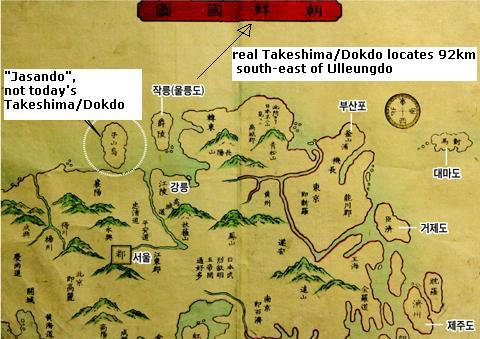
 Today, Choson online reported that Korean scholar found Japanese map in Edo era which depict Jasando(子山島) as Choson territory.
However, at a glance, if you have any knowledge of geography and the location of Takeshima/Dokdo, you can clealy understand that it is not today's Takeshima. It's locates north northwest of Ulleungodo and even bigger than Ulleungdo. Usando(Jasando) doesn't always mean today's Takeshima. Actually, never.
On the contrary to Korean claim, it is a good evidence that Japanese in Edo era did recognized so-called Jasando(Usando) was not Japanese Matsushima(today's Takeshima). Interestingly, Ahn Yong-bok testified the location of Jasando as north of Ulleungdo. It matchs those historical record. It is clear that Ahn's Jasando was not today's Takeshima. The Japanese map which depict Jasando is not rare, by the way.
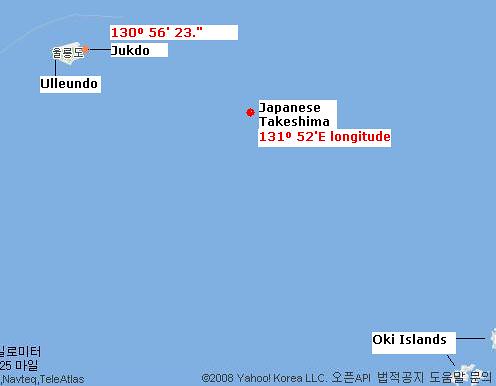 Again, Korean scholar kindly presented a good evidence that reinforce the claims by Japan. Professor 李相泰 made it clear that Usando in some maps , including 1711 official map, are Jukdo, not today's Takeshima/Dokdo on Seoul National University site. I don't understand why this Jasando looks today's Takeshima/Dokdo to him in any way. He explains that this is geographically incorrect since it was made in 1600's and Japanese then didn't have enough knowledge of Choson, then what kind of historical value this map holds in the first place? I sincerely recommend Korean to give up the fabrication that Usando was today's Takeshima, or it goes nowhere but makes looking Korean academics pathetic to all over the world. Sadly, they look like almost comedian to me.


Lord,
ReplyDeleteYes, Ulleungdo's neighboring island of Jukdo (竹島 - 죽도) is about 2.2 kilometers off Ulleungdo's east shore, and it probably can be seen most days. And, yes, the island is quite fertile and, according to the Records of King Taejong (太宗實錄 - 태종실록), people used to live on the island, but at the time, it was called "Muleungdo" (武陵島 - 무릉도), and the main island of Ulleungdo was called "Yusangukdo" (流山國島 - 유산국도), which was a mispelling of Usanguk-do (于山國島). That is most probably why old maps of Ulleungdo showed Usando to the west of Ulleungdo instead of to the east.
Here is an April 15, 1412 record from the Records of King Taejong:
---------------------
Source: 「太宗實錄」 卷 二十三, 太宗 十二年 四月 己巳條
April 15, 1412
命議政府議處流山國島人 江原道觀察使報云 流山國島人 白加勿等十二名 求泊高城 於羅津言曰 予等生長武陵 其島內人戶十一 男女共六十餘 今移居本島 是島自東至西自南至北 皆二息 周 回八息 無牛馬水田 唯種豆一斗出二十石 或三十石 麥一石出五十餘石 竹如大椽 海錯果木皆在焉 竊慮此人等逃還 姑分置于通州高城扞[杆]城
-----
의정부(議政府)에 명하여 유산국도(流山國島) 사람을 처리하는 방법을 의논하였다. 강원도 관찰사가 보고하였다. “유산국도(流山國島) 사람 백가물(百加勿) 등 12명이 고성(高城) 어라진(於羅津)에 와서 정박하여 말하기를, ‘우리들은 무릉도(武陵島)에서 생장하였는데, 그 섬 안의 인호(人戶)가 11호이고, 남녀가 모두 60여 명인데, 지금은 본도(本島)로 옮겨 와 살고 있습니다. 이 섬이 동에서 서까지 남에서 북까지가 모두 2식(息) 거리이고, 둘레가 8식(息) 거리입니다. 우마(牛馬)와 논이 없으나, 오직 콩 한 말만 심으면 20석 혹은 30석이 나고, 보리 1석을 심으면 50여 석이 납니다. 대[竹]가 큰 서까래 같고, 해착(海錯)과 과목(果木)이 모두 있습니다.’고 하였습니다. 이 사람들이 도망하여 갈까 염려하여, 아직 통주(通州)·고성(高城)·간성(扞城)에 나누어 두었습니다.”
-----
In accordance with Uijongbu orders, methods for dealing with the people of Yusanguk-do were discussed. The governor of Kangwon Province reported, "Twelve people from Yusanguk-do, including Baek Ga-mul, came and anchored at Eorajin in Koseong and said the following:
"We grew up on Mu-leungdo, where 11 families lived with a total of more than sixty men and women. Now we have moved to the main island and are living there. The island's distances from east to west and north to south are each two shik (60 ri), and its circumference is eight shik (240 ri). There are no cows or horses or rice paddies on the island, but if we plant just one mal of beans, we harvest twenty to thirty seok. If we plant one seok of barley, we harvest more than fifty seok. The bamboo are as big as rafters, and there are all kinds of sea products and fruit trees."
Fearing that they may try to run away, they were divided up and put at Tongju, Koseong, and Ganseong, where they are still.
------------------
Notice that it said that more than 60 people had lived on Muleungdo (武陵島 - 무릉도) before moving to the main island, which we know was Yusangukdo (流山國島 - 유산국도) since the people were described as having come from there. In this instance, Muleungdo was almost certainly referring to Ulleungdo's neighboring island of Jukdo (竹島).
As your pictures show, Ulleungdo's neighboring island of Jukdo (竹島) seems to have been big enough to support sixty people, even though they would have had to survive off rain water since there is no water on the island. They probably lived on Jukdo because they probably thought it was easier to defend. However, later they must have decided that it was safe enough to move to the main island (Ulleungdo).
When old Korean records referred to the distance between Usando and Muleungdo (Ulleungdo) as being close enough that they could be seen on a clear day, they were referring to the distance from the Korean mainland to the two islands, not to the distance between the two islands.
The following is from the Records of King Sejong
-------------------
于山武陵二島 在縣正東海中 二島相去不遠 風日淸明 則可望見 新羅時 稱于山國 一云鬱陵島 地方百里
우산(于山)과 무릉(武陵) 2섬이 현의 정동(正東) 해중(海中)에 있다. 그 두 섬까지 가는 거리가 멀지 아니하여, 날씨가 맑으면 가히 바라볼 수 있다. 신라 때에 우산국(于山國), 또는 울릉도(鬱陵島)라 하였는데, 지방(地方)이 1백 리이며...
The two islands of Usan and Mu-leung are due east of the present "hyeon" (Uljin), and the distance between them is close enough that they are visible on a clear, windy day. In the time of Silla, they were called Usan-guk or Ulleungdo. It has an area of 100.
---------------------
Notice that it gave the bearing from the village on the mainland (Uljin - 蔚珍縣 -울진현), which means that the distance being referred to was the distance from Uljin to the two islands. In other words, the two islands were thought of as an island group. This was confirmed by the fact that only one area (100 ri was given for the two islands.
Also, the following old Korean maps show that the two islands of Ulleungdo and Usando were considered a 2-island group since the the phrase 鬱陵干山兩島 (the two islands of Ulleung & Usan) was written on just one island. The maps of Ulleungdo in the same atlases show that Usando was the smaller neighboring island.
1736~1767 Yeojido (輿地圖)
Mid 1700s - "Paldo Yeojido" (八道 輿地圖)
1737~1776 - "Gwang Yeodo" (廣輿圖)
By the way, none of the main posters on this blog are professional historians, as far as I know. I, myself, am an American English teacher here in Korea, who became interested in the Dokdo/Takeshima dispute a few years ago. Three years ago none of us knew much at all about the history.
I hope that answered your questions.
My sweet lord,
ReplyDeleteYou seem to be a honest person. I'm glad to know to read your opinion.
To follow is my (pacifist's) thought:
(1)About the 二島相去不遠 , I think it mentioned as the "二島" (the two islands) are not so distant from the author's place (Korean peninsula).
I have heard that in older days in Korea, they used to write the distance of islands with the distance from the Korean mainland. So I think as long as the author was staying in Korean peninsula, the distance should be measured from Korean peninsula.
As I mentioned in somewhere else, "相" doesn't always mean "each other of the two islands" here.
The sentence 相去不遠 can be interpretable as the distance between two points that faces eye to eye (相) is not so far.
So it can be meant as the translated sentence above.
If so, 風日清明 則可望見 can be understandable. The two islands can be easily visible (from the Korean peninsula) when days are fine.
And there is a theory that the shape of Ulleungdo viewed from a place on the Korean peninsula, such as Samcheok, may have been irregular, which may have been viewed as two or three islands. If there are reports that there is an inhabitable island (Usando) beside Ulleungdo, one must have misunderstood that they saw were Ulleungdo and Usando. This theory is still a possibility but I think it must be highly possible.
(2) I didn't read the site yet but I must point out that there was no "Dokdo" in the ancient times. Are you saying about "Usando"?
If you meant Usando, it has been widely known that people were living there.
http://dokdo-or-takeshima.blogspot.com/2007/10/where-have-all-usandos-gone.html
So it is a proof that Usando was not Liancourt Rocks, uninhabitable rock island.
I will answer to this.
ReplyDeleteGTOMR said...
于山武陵二島在縣正東海中
Okay, I wil ask questions
What is the subject and object of those phrases which omitted in the phrases.
a)二島相去不遠
b)風日清明、則可望見
C)新羅時、称于山国
D)一云鬱陵島地方百里
Thank you.
11:31 PM
a) 二島 : two islands
b) here is no subject and also no object.
but actually those 4 a,b,c,d, are two sentences.
one is a,b.
the second is c,d.
like this,
二島相去不遠 風日清明、則可望見
but, why did you put a comma in here? 風日清明、則可望見
is there a comma in the "sejong sillok"?
or did you put that by yourself?
And, this
新羅時、称于山国一云鬱陵島地方百里
again a comma.
DON'T DO THAT.
NEVER!
YOU DON'T HAVE ANY RIGHT TO CHANGE THAT SENTENCE.
anyway, the first sentence is the important sentence.
anyway
于山·武陵二島 在縣正東海中 二島相距不遠 風日淸明 則可望見 新羅時 稱于山國
this is the original sentences.
in here
二島相距不遠 風日淸明 則可望見
we have to decide something.
what is subject and object?
but, why do we have to think about the object?
Actually I think there is one subject. and that' all.
we don't need to put a object in that sentence and also even the 去---blank.
hahah
why should we do that?
That sentence doesn't need the object, because there is one subject (二島), so they didn't repeat again.
I mean that the translation is this.
二島(two islands) are not so far(距不遠) from each other(相) that when it is clear(風日淸明: 風wind, 日sun, 淸clear, 月moon =>this means just good weather. don't you agree?)
they can see each other.
the reason is that at the first of this sentence there is the subject and 相,actually I think this 相 is not just a adverb but, I think 相 is like a adjective which supplement the 二島.
So the subject is 二島相 meaning "each of them".
So now are you satisfied with that?
Or do you want to translate more about the second sentence?
Come on, I am really busy nowadays.
Anyway, as I suggested, we should understand the Chinese old sentences by the FACT.
Then I have a big question.
From the east cost-line of Korean peninsula, could we see the "two island"? even the "Ullung-do" ?
I don't think so.
Is there any proof for that? execpt the simulation and the old documents which is not clearly interpreted.
Is there any real thing to prove your idea? like a photo?
I have a real proof, a PHOTO of Dok-do which is taken in the "Ullung-do".
Photo of Dok-do from Ullung-do
As I said, we should understand the old documents by the real fact, because there are a lot of mistakes in there.
And also the later documents tended to follow those mistakes, cause they always refer to the older documents.
So we must understand the old documents by the real FACT.
(and sorry, I may not come back or not..if I have some free time.)
And I am really wondering
ReplyDelete"where is the pantom island?"
And even if there is the phantom island, that can't be seen from main Korean peninsula, as the name of the island.
Now we are talking about the "sejongsilokjiriji, 世宗實錄地理志".
More precisely about the two island which is visible from the mainland.
I don't understand why do you mention that island, just for proving my ignorance on geography?
ha
(sorry for my rudeness, but did you expect that Korean would be nice in this situation? )
.........
juuno,
ReplyDelete"于山·武陵二島 在縣正東海中 二島相距不遠 風日淸明 則可望見 新羅時 稱于山國
this is the original sentences.
in here
"二島相距不遠 風日淸明 則可望見"
"二島(two islands) are not so far(距不遠) from each other(相) that when it is clear(風日淸明: 風wind, 日sun, 淸clear, 月moon =>this means just good weather. don't you agree?)
they can see each other."
Wrong. It happens when you don't read it in a whole sentence. (Actually, it should be read in a whole chapter.) You need to read whle original sencence(于山·武陵二島 在縣正東海中 二島相距不遠 風日淸明 則可望見 新羅時 稱于山國) or you make mistake like you just did.
"From the east cost-line of Korean peninsula, could we see the "two island"? even the "Ullung-do" ?"
In those days (before 1700s), Usando and Ulleungdo were confused and Korean were not sure if there are really two islands or they are the same island. This sentence from 世宗実録 prove this confusion and it matches with the real situation that those two islands are so close (if they are two islands) that those two islands (group) can be seen from peninsula(江原道襄陽縣). This is supported by other documents and Korean old maps.
1452年 - 「高麗史」巻五十八 地理三
"在縣正東海中 新羅時 称于山国 一伝武陵、一伝于陵 一云 于山 武陵 本二島、相距不遠 風日清明 則可望見"
1454年 - 「世宗実録」 地理志 江原道襄陽縣
"于山 武陵 二島 在縣正東海中 二島相去不遠 風日清明 則可望見 新羅時 称于山国 一云鬱陵島 地方百里 恃険不服"
1481年 - 「東国輿地勝覧」巻四五
"蔚珍縣 于山島 鬱陵島 一云武陵 一云羽陵 二島在県正東海中 三峯及業掌空 南峯梢卑 風日清明則峯頭樹木 及山根沙渚 歴々可見 風便則二日可到 一説干山 鬱陵 本一島 地方百里"
1530年 - 「新増東国輿地勝覧」
"蔚珍縣 于山島 鬱陵島 一云武陵 一云羽陵 二島在県正東海中 三峯及業掌空 南峯梢卑 風日清明則峯頭樹木 及山根沙渚 歴々可見 風便則二日可到 一説干山 欝陵 本一島 地方百里"
1656年 - 「東国輿地志」巻之七 江原道 蔚珍
"于山島 欝陵島 一云武陵 一云羽陵 二島在県正東海中 三峯及業掌空 南峯梢卑 風日清明則峯頭樹木 及山根沙渚 歴々可見 風便則二日可到 一説干山 欝陵 本一島 地方百里"
By the way, juuno, I'm thinking about sending warning letters to the law schools in D.C. and ask them to notify Japanese students in School to be careful since you had commented so many unrlated racial slurs against Japanese. I think you don't mind. What do you think? I thought you were just a kid because you acted childish, that's why I didn't reported to the Korean police when you thereatened raquel to kill him/her, but if what you said is true, and you are really an adult, that is another story.
Maybe you don't understand, but I'm extremely disturbed and angry with your attitude and continuous racial slurs against Japan.
Kaneganese,
ReplyDeleteI will not allow Juuno to reply to anything that is not related to Dokdo/Takeshima, so do not expect a reply to the last part of your comment. I do not want to see another irrelevant argument get started.
Gerry,
ReplyDeleteI'll send you a e-mail later. Anyway, I hope you understand I'm not happy with "Japs""racists" comments at all.
Could you make a post to explain how to read and translate those sentences in many Korean documents in Korean and English? Then we don't have to keep telling Korean about that. I've actually noticed they can't read 漢文 at all and the situation is very serious. They can be easily brainwashed by scholars who intentionally misread to fit their theory. I think something has to be done to stop it for Korean's sake.
1452年 - 「高麗史」巻五十八 地理三
"在縣正東海中 新羅時 称于山国 一伝武陵、一伝于陵 一云 于山 武陵 本二島、相距不遠 風日清明 則可望見"
1454年 - 「世宗実録」 地理志 江原道襄陽縣
"于山 武陵 二島 在縣正東海中 二島相去不遠 風日清明 則可望見 新羅時 称于山国 一云鬱陵島 地方百里 恃険不服"
1481年 - 「東国輿地勝覧」巻四五
"蔚珍縣 于山島 鬱陵島 一云武陵 一云羽陵 二島在県正東海中 三峯及業掌空 南峯梢卑 風日清明則峯頭樹木 及山根沙渚 歴々可見 風便則二日可到 一説干山 鬱陵 本一島 地方百里"
1530年 - 「新増東国輿地勝覧」
"蔚珍縣 于山島 鬱陵島 一云武陵 一云羽陵 二島在県正東海中 三峯及業掌空 南峯梢卑 風日清明則峯頭樹木 及山根沙渚 歴々可見 風便則二日可到 一説干山 欝陵 本一島 地方百里"
1656年 - 「東国輿地志」巻之七 江原道 蔚珍
"于山島 欝陵島 一云武陵 一云羽陵 二島在県正東海中 三峯及業掌空 南峯梢卑 風日清明則峯頭樹木 及山根沙渚 歴々可見 風便則二日可到 一説干山 欝陵 本一島 地方百里"
I think you had an excellent review of 高麗史, but Korean historial usually use "二島相去不遠" from 世宗実録 to suit their theory and then read other sentences as well. I think we should notify their translation is not true.
kaneganese,
ReplyDeleteCould you tell me what is wrong in my interpretation?
Don't say that is just wrong.
If you want to say that's wrong, you should say the reason.
why? was my idea wrong?
(I will not mention about the last comment of you, cause Gary will not allow. But I will remember not olny your last comment, but also whole things in here.)
juuno,
ReplyDeleteI've already explained the reason to you.
"You need to read whle original sencence(于山·武陵二島 在縣正東海中 二島相距不遠 風日淸明 則可望見 新羅時 稱于山國) or you make mistake like you just did."
The sentence is telling about 于山·武陵二島. This is the subject that cover whole sentence. Beside, there is no 互 nor 相 in 則可望見. Thus, it(則可望見) should be read that those two islands can be "seen from 縣", not "seen from each other". And the translation is supported by other documents as I posted before. (風日清明則峯頭樹木 及山根沙渚 歴々可見 風便則二日可到)
juuno wrote,
(I will not mention about the last comment of you, cause Gary will not allow. But I will remember not olny your last comment, but also whole things in here.)
juuno, I'll take it as Yes.
Kaneganese,
ReplyDeleteI realize that you were upset, but from what I saw the argument was accomplishing very little if anything. By the way, I have not allowed two of GTOMR's comments because he referred to Juuno as "kid," which is a name that Juuno obviously does not like. Anyway, don't let Juuno provoke you.
I have thought about translating some of my arguments into Korean, and may start doing that in the near future.
Thank you for the compliment, but what I posted about the distance from Ulleungdo and Usando came from King Sejong's geography text (地理志) description of Uljin (蔚珍縣) HERE. However, they are all essentially saying the same thing.
Have you looked at the maps on CMS1530's site that I linked to HERE? He has some very enlarged copies of the Ulleungdo maps and others.
Take care.
Gerry,
ReplyDeleteI've sent you an e-mail.
I, and probably GTOMR, too, simply thought he is just a high school or junior high school kid from his childish attitude, lots of "~"s and poor knowledge of 漢文 and Korean history. And I am really surprised to know he is not a kid, but a adult. That's what upset me.
Anyway, I can't find the post you made on occidentalism which I thought written about 高麗史, not 世宗実録地理志. I'll try to find it tomorrow. But please consider making a post about those sentences.
The point is, 世宗実録地理志 has exceptional sentence, all those sentences including 世宗実録地理志 itself are saying same thing. "Two islands (Usan and Ulleungdo) can be seen from Korean peninsula."
I've tried to explain it to juuno and lord, but it looks like I failed. Maybe if you say it in Korean, it might help them understand the sentences.
to anyone,kaneganese or Gtomr or pacifist,
ReplyDelete『成宗實錄 』卷 一百二十五, 成宗 十二年 一月 甲申條 1481,
link1
永安道觀察使李克墩 上三峯島搜得之策 一 東北之海 風浪險惡 非他海之比 且不知三峯島 的在何處 差人入送爲難 但本道人民 皆是遷徙之徒 撤擧家産 不以爲難 性又愚惑 信聽誑語 若不扵此時 搜得此島 明其背國之罪 則愚民必曰國家大擧欲討 而終不得 他日我雖徃投 國家終無乃我何 則非細故也 倘有水旱之災 兵戈之役 則必有逃徃背國之人 臣意 妄謂如今年招撫使之擧 則倘有蹉跌 其悔甚大 宜如敬差官曺偉時例 令本道自望人三十餘名 齎諭書入送 探知島之所在 勢可招撫則招之 如不可敵則更遣師徃討 亦爲未晩 且徃返之間 縱有所失 不至大悔 一 前者徃來者 或云遙見 或云不得見 莫辨眞僞 今也 遣人搜覓 如終無此島 則將初發言金漢京輩 明其誑語惑衆之罪 置之極刑 傳屍一道 以示衆目 則愚民亦知三峯島之必無 而其胥動之惑 自解 一 如明年春節入送 則須扵正月晦時 諸事畢辦 二月初 到浦 待風爲便 待風只數十日之事 如遷延數旬 値霖雨 則無風海暗終無發船之理 命議于領敦寧以上 鄭昌孫沈澮尹士昕尹弼商洪應盧思愼李克培尹壕議 三峯島搜覓事 從第一條 令本道 自望人三十餘名 齎諭書入送 探覓島之所在 的知在某處 則更遣使招之 如或不從 遣師徃討爲便 從之
could you translate to English thi
s document for everyone?
just let me do some part of that.
==============================
"king, Sungjong's hystory, sungjong's 12years" 1481,
---------------------------------
the king tried to find the "三峰島"
---------------------------------
and which island is "三峰島"?
some scholars ,like 'kaneganese' in his post 張漢相found三峰島
, said that is just the other name of "ullung-do".
But, can you translate this sentence for everyone?
or do I ?
從第一條 令本道 自望人三十餘名 齎諭書入送 探覓島之所在
this is in the last part.
(As the no. 1 order, select 30 persons from 本島-main island or this island, and make them find the location)
then what is the 本島-main island ?
we can infer from this.
但本道人民 皆是遷徙之徒
the people of 本島 is not so wise~~
------------------------------
kaneganese said in his post above,
三峰島 is "Ullung-do".
then where is this 本島?
is there any other big island where goverment can choose 30 persons, except "ullung-do"?
Look Google.
in the east sea, is there another big island? execpt "ullung-do" ?
----------------------------
So this 本島 must be "ullung-do".
Then which island is the"三峰島"?
"juk-do" doesn't need to find, cause jukdo is located near 2km from ullng-do.
==========================
And another record, in 1476
link2
成宗實錄』 卷 七十二, 成宗 七年 十月 壬辰條 1476
兵曹啓 永興人金自周供云本道觀察使 以三峯島尋覔事 遣自周及宋永老 與前日徃還 金興金漢京李吾乙亡等十二人 給麻尙船五隻入送 去九月十六日於鏡城地瓮仇未 發船向島 同日到宿富寧地靑巖 十七日 到宿會寧地加隣串 十八日 到宿慶源地末應大 二十五日 西距島七八里許到泊 望見則於島北 有三石列立 次小島 次巖石列立 次中島 中島之西 又有小島 皆海水通流 亦於海島之間 有如人形 別立者三十 因疑惧 不得直到 畫島形而來 臣等 謂徃年朴宗元 由江原道 發船遭風 不至而還 今漢京等 發船於鏡城瓮仇未 再由此路出入 至畫島形而來 今若更徃 可以尋覔 請於明年四月風和時 選有文武才者一人入送 從之
here, one man-金自周 said about the
三峰島 and described that island.
he said "there are something like
dolls(人形)". many scholar think the dolls is 'fur seal,海狗,물개'.
As you know, there were lots of fur seal near "dok-do", before japanese fisherman exterminated those during 1905-1945.
this is 5years before than previous record.
this record made the king,sung-jong try to find the"三峰島".
=================================
then what do you think?
which island was needed to find? from 本島,ullung-do?
by about 30 person?
the juk-do? or the~ phantom?
OR this "DOK-DO"?
I also know there were a lot of confusing in the old documents ABOUT "三峰島".
but in these two record, I can confirm that "三峰島" is the "DOK-DO".
FROM, THIS RECORD,
THERE ARE LOTS OF RECORD ABOUT "DOK-DO".
in the 숙종 (조선 왕) [肅宗]'實錄 like 안용복 (조선 어부) [安龍福,
and so on.....
-------------------------------
What do you think of these two record?
And the king,sungjong tried to find the "三峰島" several times,
ReplyDeleteand finally
in the years of "king suk-jong"
there are lots of record and expression like 可支島 meaning "fur seal island".
----------------------------
If the 三峰島 were "ullung-do", then the king wouldn't have to try to find that island from the 本島(main island).
what do you think of 本島?
Korean peninsula is not a "島",but a peninsula.
Thank you.
二十五日 西距島七八里
ReplyDeleteAnd from this 七八里.
the distance between the ship where "kimchaju" looked the island, and 三峰島.
In this 七八里 is 7,8 里=about 3km, they couldn't watch the whole big island "Ulleung-do"
But, they could watch the whole "DOK-DO" and they could describe.
Thanks.
to Lord,
ReplyDelete힘들어 죽겟어요, 이제 출국 해야 하는데 저 미쳐있는 듯 지금 ㅋ..ㅋ
ㅎㅎㅎ^
the 7,8 里= 3km.
ReplyDeleteThey could misunderstand the 30 "fur seal"s as 人形.
-------------------------
thanks, again..
Dear lord,
ReplyDeleteThanks for your opinion.
You wrote that the distance of 2.2km is strange to say "can easily view on fine days", that's true.
Then please think about my posting that the text may mean "the two islands can be easily viewed from the Korean peninsula on fine days".
It is far more reasonable than the "Dokdo" theory because Korean people in those day usually wrote the distance of islands based on Korean peninsula.
So if the author was writing the document at Korean peninsula, he should have meant about the distance of them (two islands) from the place where he was.
Juuno,
ReplyDeleteYes, King Sejong tried to find Sambongdo (三峯島), but he never found it because Sambongdo was just another name for Ulleungdo, which was well-known for its three most prominent peaks.
In Korea's Chungwanji (春官志 - 춘관지), Ulleungdo was called Sambongdo (三峯島). See HERE.
junno,
ReplyDeleteKaneganese wrote the text about Sambongdo here:
http://dokdo-or-takeshima.blogspot.com/2008/04/1470-sambongdo-was-another-name-of.html
All the episodes, which you showed in two separate references in Chinese letter, were included in the above article.
Dear pacifist,
ReplyDelete6:00 PM
한문으로 쓰여진 원문이 상세하게 기술되어 있지 않아서 혼란을 줄 수 있다는 것을 인정합니다.
토론을 위한 자리이기 때문에, 더 많은 글들과 같이 분석해 보아야 정확한 의미를 서로 인정할 수 있을 것 같습니다.
한반도에서 두 섬을 보았을 경우의 문제에 대해서는, 더 많은 글들을 찾아보고 생각해보도록 하겠습니다.
의견 주신 것에 대하여 감사드립니다.
Then what do you think of the 松島 and 竹島 before 1905?
ReplyDelete//元祿九丙子年朝鮮舟着岸一卷之覺書//
安龍福申候ハ竹嶋ヲ竹ノ嶋とと申朝鮮国江原道 東萊府ノ内鬱陵嶋と申嶋御座候是ヲ竹ノ嶋と申由申候 則 八道ノ圖記之所持仕候松嶋ハ右同道之内子山と申嶋御座候是ヲ松嶋と申由是も八道之圖記申候
(생략)
一、安龍福申候ハ 私乘参候船ハ拾壱人伯州参取鳥伯耆守樣御断之義在之罷越申候 順総布※候而当地へ奇申候 順次第泊州渡海可仕候 五月十五日竹嶋出船 同日松嶋着 同十六日松嶋ヲ出 十八日之朝隱岐嶋之內 西村之磯ヘ着 同二十日大久村入津仕候由申候 西村之磯ハ荒磯而御座候付 同日中村入津是□之惡候故 翌十九日彼所出候而同日晩 大久村之內かよひ浦と申所舟懸リ仕二日大久村参懸リ居申候
一、 竹嶋と朝鮮之間三十里竹嶋と松嶋之間五十里在之由申候
一、 安龍福ととらべ 武人四年已前酉夏竹嶋而伯州之舟被連まいリ候とらべも此度召連参り竹嶋
Gerry,
ReplyDeleteyou should know Korean LAW.
specially the criminal law.
we are generous to foreigners.
But according to situation, it can be changed.
now your blog is very famous because of the vote.
Also in japan, there are lots of advertisement and anouncement about this blog. we also know this.
In Korean Law, we can punish any foriegners who is located in Korea.
Look this site.
http://www.lawnb.com/lawinfo/law/info_law_searchview.asp?ljo=l&lawid=00332900
And look more carefully,
the 2條 and
from 92條 to 104條.
If we had a battle with Japan, we couldn't know about the result of that.
Look more detaily 92條.
I will translate for you and the other Japanese.
92條 (외환유치) 외국과 통모하여 대한민국에 대하여 전단을 열게 하거나 외국인과 통모하여 대한민국에 항적한 자는 사형 또는 무기징역에 처한다.
92. Anyone who makes foreign country to start a war or battle on Korea By the communiction with foreign country,
Anyone who resistes Korea
Can be condemn to death penalty or penal servitude for life.
and 2條,(국내범) 본법은 대한민국영역내에서 죄를 범한 내국인과 외국인에게 적용한다. shortly means that this law is applied to anyone in Korea.(including foreigners and of course Korean who violate our law in Korea)
5條.외국인의 국외범) 본법은 대한민국영역외에서 다음에 기재한 죄를 범한 외국인에게 적용한다.
1. 내란의 죄
2. 외환의 죄
3. 국기에 관한 죄
4. 통화에 관한 죄
5. 유가증권, 우표와 인지에 관한 죄
6. 문서에 관한 죄중 제225조 내지 제230조
7. 인장에 관한 죄중 제238조
for some criminal like 92~104條, foreigner who violate these 6 part of law in foreign country, can also be punished.
you should also know our Law ,not only the geography and history.
Actually I didn't do anything to you and them.
however if there are some Korean who are very angry with this blog, it could be a big problem.
racism is a samll thing, but your actions here could be understood as a spy's job.
specially if you and they collect some documents or information in Korea, it would be more possible.
And kaneganese and pacifist are Japanese.
they can have more serious situation.
you should know this and you sould also warn to them.
Someone like me, just say "JAP" and do nothing.
but, the others who are silent, can do anything.
you must know this!!!!!
to Gerry,
ReplyDeleteI want you to kanedanese about the law.
And I will wait for your answer by today midnight.
And if kaneganese don't say "sorry to me",
then I will do an action, a legal one.
Don't test my patience.
And I wish to know the meaning of "I will take it as yes."written by kaneganese about my comment.
I really think that you and they are ignorant on Korean Law, specially the Criminal LAW.
And I think they,japanese tent to neglect Korean and the Korean law.
kaneganese said" if i am an adult, that's another story."
Yse, that's right.
now I am ready for my doing.
And this is their turn and also yours.
is their have any exoneration as a diplomatic official?
are they in diplomatic position?
And are you?
Now I am warning you and them seriously about the result of this blog.
I will wait by this mid-night.
Don't you know why I showed up my identity?
In Korea, here is a proverb.
" The young kid dog don't know how strong and terrible the tiger is."
You should also know.
Korean people is knid and generous, but if they are really angry, you can see what is the result.
I SAY NOW AGAIN.
"I WILL WAIT YOU AND THEIR ANSWER BY TODAY'S MIDNIGHT, 12PM."
THEN I WILL DO SOMETHING LEAGAL.
THANK YOU.
(And this is not only for myself, but also for the benefit of Republic of Korea, according to the law.)
bye.
And if she or he had already sent any letters to my law school in DC,
ReplyDeleteHE or SHE must pack her bags to go back to Japan.
or TO GO TO JAIL.(of course Korean jail)
I PROMISE YOU. I GRADUATED FROM LAWS SCHOOL IN SNU, as you might see my gr certifiticate in my bolg.
I know the laws in korea and I also know many people in the court.
Now I will go to USA to study international law for this kind of thing like the territorial thing.
And I think you, Gerry should also be careful, cause MANY KOREAN PEOPLE NOW LOOK THIS BLOG BECAUSE OF THAT STUPID "VOTE".
YOU've been HELPING THOSE JAPANESE SPY.
THEY ARE SPY TO KOREA, CAUSE THEY COLLECT OUR DOCUMENTS FOR THE BENEFIT OF JAPAN.
DO YOU REALLY THINK THIS BLOG IS FOR TEACHING KOREAN? HA
BE CAREFUL.
I wish you not to be harmed.
junno,
ReplyDeleteIf you are really a studen of a law school, you may know about extortion or blackmail. Your last few postings seems to be blackmails.
And it was Korea who robbed Liancourt Rocks, not Japan. As we've shown in this blog, there is no evidence that Korea owned the island before 1905. It was a kind of invasion of Japanese territory by Korea. You should learn about the SF Peace Treaty in the law school.
Please read the following
and understand the international law.
http://dokdo-or-takeshima.blogspot.com/2007/12/report-of-van-fleet-mission-to-far-east.html
I hope you will understand the whole situation. Thank you.
juuno,
ReplyDeleteCould you tell us what the maximun penalty expected for making a threat of physical harm is under the Korean criminal law?
Thank you.
___________________________________
In Korean Law, we can punish any foreigners who are located in Korea.
I know the laws in Korea and I also know many people in the courts.
juuno,
ReplyDelete"BE CAREFUL.
I wish you not to be harmed."
Holy Molly...Now are you threatening me and Gerry? Are you out of your mind? This is serious offence if it happened in Japan. I've already warned you that it's going to destroy your future when you thereatened to find raquel and kill him/her. In case, you don't realize, I'm not in Korea and I'm totally free from Koran law unless I had done anything illegal in Korea.
Anyway, this is not an appropriate topic we should discuss on this blog, so please visit my temporary testing blog here.
http://thetruthoftakeshimadokdo.blogspot.com/
Actually, I hadn't sent them yet simply because I've been busy with my summer sale shopping. We can talk about the situation you are facing over there.
I have allowed the above two comments from Juuno on this non-topic issue to let people know that they have been "warned," but I will not allow the name-calling debate to get started, again. Also, I have allowed one comment from Raquel to help balance Juuno's comments with her grievance, but I will not allow any more, unless it is about Dokdo/Takeshima.
ReplyDeleteIf Pacifist and Kanegenese respond, I hope they respond with a historical argument rather than renewing the old argument with Juuno.
Personally, I think Juuno has a lot of gall to threaten legal action after having written some very nasty, childish comments on this blog.
Anyway, I will not respond to anymore to his threats or allow anymore of them to be posted. I will allow him only to comment on the subject of the Dokdo/Takeshima dispute.
kaneganese,
ReplyDeletein your blog, I can't write.
how about fixing that?
;)
And,
ReplyDeletethe Korean Imperial Edict No. 41 (대한제국 칙령 제41호),1900
"郡廳位置는台霞洞으로定하고區域은鬱陵全島와竹島石島를管轄할事"
here, 竹島石島.
even as the 'raquel's theory,
that means a 石島(stone island) called 竹島(takeshima),
that is the "dok-do".
and also because 鬱陵全島 means whole islands group of 鬱陵島.
juk-do is just one of the group.
as kaneganese and wiki dictionary said.
but, Japan insist this 竹島石島 is their island, in 1905, illegaly.
And also took our right of diplomacy by the "threathening" our king.
And 1945 the "JAPAN" EMPIRE" was destroyed.
Then we recovered our island.
do you understand?
or do you want to repeat more?
:)
junno,
ReplyDeleteIf you insist "Stone island called Takeshima (竹島)" theory, it is definitely Ulleungdo's neighbouring island Jukdo (竹島), not Liancourt Rocks, because the name of "Takeshima" was named in 1905 for the first time so that Liancourt Rocks were not Takeshima in 1900 when the Imperial Edict was made.
Jukdo is a kind of rock island with a unique shape. So if you interpret that 竹島石島 should be a "stone island called 竹島", your theory is indicating that it was not Liancourt Rocks.
Actually that is not my theory,
ReplyDeleteBut the "RAQUEL'S THEORY"
OK?
And as your theory in here,
ReplyDeleteJuk-do is the "jasando" as like in this blog.
THEN DID YOU CHANGE YOUR MIND ABOUT THE "JUK-DO".
IS THIS "JUK-DO" ,THE "竹島" OR "JASANDO" ?
And still I am wondering abot the "竹島" and "松島" before 1905.
ReplyDeleteas I asked all of you!! ,in the previous comment.
And also in the previous map.
http://www.dokdo-takeshima.com/color-code-dokdo.jpg
http://blog.daum.net/gijuzzang/5545603?srchid=BR1http%3A%2F%2Fblog.daum.net%2Fgijuzzang%2F5545603
ReplyDeleteyou should also see this site.
this is about the name of "dok-do"
anyway, I am busy.
if someone wants, i will translate later.
see you.
junno,
ReplyDeleteAs for the map, as I wrote somewhere before, the 竹島 (Takeshima) in he map is Argonaut island which is a phantom island and the 松島 (Matsushima) in the map is Dagelet island (Ulleungdo).
It is easily understsandable when you can read the longitudes.
As to the longitudes, please read the article here:
http://dokdo-or-takeshima.blogspot.com/2008/06/1899-american-map-of-japan-and-1894.html
Also about the 竹島 as Argonaut island and the 松島 as dagelet island, please read here:
http://dokdo-or-takeshima.blogspot.com/2008/07/1894-japanese-map.html
As to the two islands (Argonaut and Dagelet islands), please read here:
http://dokdo-or-takeshima.blogspot.com/2008/07/1817-aaron-arrowsmiths-map-of-japan-and.html
Many American maps from the 19th century also showed Argonaut island as Taka Shima (=Takeshima,竹島) and Dagelet island as Matsu Shima (=Matsushima,松島). An example is here:
http://dokdo-or-takeshima.blogspot.com/2008/07/1891-american-map-of-japan.html
Another example is here:
http://dokdo-or-takeshima.blogspot.com/2008/06/1897-american-map-of-japan-and-korea.html
juuno,
ReplyDeleteThat's not my theory.
That theory belongs to your teacher, Prof. Sang-Myon Rhee of the SNU College of Law:
http://pipl.com/directory/people/Sang-Myon/Rhee
Anyway, although his interpretaion as a whole is totally wrong, he has "carelessly" put a little undeniable light on one thing which is very crucial:
"石島" can be interpreted as "a 石島" meaning just a rock island.
___________________________________
even as the 'raquel's theory,
that means a 石島(stone island) called 竹島(takeshima),
that is the "dok-do".
and also because 鬱陵全島 means whole islands group of 鬱陵島.
juk-do is just one of the group.
The map shows that Daemado (Tsushima) belonged to Korea.
ReplyDeleteNice side effect !
I don`t understand why everybody is so obsessed with maps. Come on guys, 500 AD and two really small rocks?
ReplyDeleteYou must be kidding.
Not for nothing, but do these ancient maps, false or otherwise, even matter? If one were to read the Rusk documents it is clearly evident that the Liancort Rocks were never considered part of Korean territory and were not included in the Peace Treaty of San Francisco.
ReplyDeleteAfter a quick search I found these interesting websites:
http://www16.tok2.com/home/otakeshimaoxdokdox/International%20Law/RuskDocumentsTreatyofPeacewzJapan.htm
http://en.wikisource.org/wiki/Possible_Methods_of_Resolving_Liancourt_Rocks_Dispute_between_Japan_and_ROK